The Waste Product You Breathe
Photosynthesis is the set of biological processes by which autotrophic organisms — most plants, algae and cyanobacteria — convert light energy, typically sunlight, into the chemical energy that fuels their metabolism.
The usual meaning is oxygenic photosynthesis, and the definition contains a detail worth sitting with: it releases oxygen as a byproduct of water splitting. Oxygen is not the point of the exercise. It is what gets thrown away when the plant cracks water apart to get at the hydrogen.
Every breath you take is powered by something else's discarded waste. Photosynthesis plays the critical role in producing and maintaining the oxygen content of Earth's atmosphere, and it supplies most of the biological energy that complex life depends on. The captured energy gets stored in the bonds of organic compounds — carbohydrates such as glucose, fructose and sucrose, plus starches and cellulose — and released again later through cellular respiration.
Why Leaves Are Green
The process always begins the same way: light energy is absorbed by reaction centres, proteins holding photosynthetic pigments.
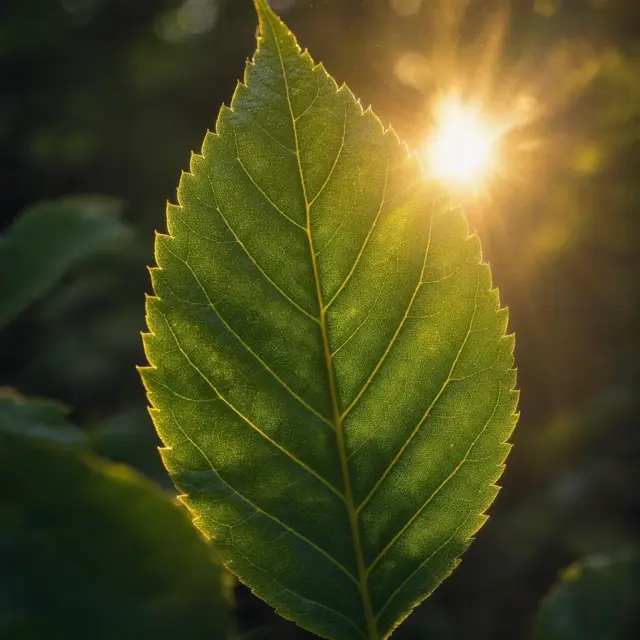
In plants those pigments are chlorophylls, held inside chloroplasts which are abundant in leaf cells. And chlorophyll's colour is a process of elimination. It absorbs the red and blue parts of the spectrum — and reflects green. The green of every forest on Earth is the light plants had no use for.
In the light-dependent reactions, some of that energy strips electrons from suitable substances such as water, producing oxygen gas. The hydrogen freed by splitting water goes into making two crucial molecules: NADPH and ATP, the latter often called the energy currency of cells. In cyanobacteria the same pigments sit embedded in the plasma membrane rather than inside chloroplasts.
Building Sugar Out of Air
The second half of the process needs no light at all. In plants, algae and cyanobacteria, sugars are built by a sequence of light-independent reactions called the Calvin cycle.
Here, atmospheric carbon dioxide is incorporated into organic compounds that already exist, such as ribulose bisphosphate. Using the ATP and NADPH generated by the light-dependent reactions, those compounds are then reduced and removed to form further carbohydrates, including glucose.
Stated plainly, a plant assembles solid matter out of an invisible gas. Other bacteria reach the same end by different mechanisms, such as the reverse Krebs cycle. The scale of the operation is difficult to hold in mind: photosynthetic organisms convert roughly 100–115 billion tons of carbon into biomass every year.
The Version That Came First
Oxygen-producing photosynthesis was not the original. Some organisms perform anoxygenic photosynthesis, which produces none at all.
Certain bacteria, such as purple bacteria, use bacteriochlorophyll to split hydrogen sulfide instead of water, releasing sulfur rather than oxygen. Archaea such as *Halobacterium* run a different system again, using the simpler pigment retinal to absorb green light and drive a proton gradient across the cell membrane, powering pumps that make ATP directly. That archaeal version might be the earliest form of photosynthesis that ever evolved.
The first photosynthetic organisms probably used reducing agents like hydrogen or hydrogen sulfide as their electron source. Cyanobacteria appeared later — and the excess oxygen they produced drove the oxygenation of the Earth, which is what made complex life possible in the first place. Photosynthesis itself was discovered in 1779 by Jan Ingenhousz, who showed that plants need light, not merely soil and water.