It Started With Milk, Blood and Eggs
The story of plastic does not begin in an oil refinery. It begins with food.
Early plastics were bio-derived materials such as egg and blood proteins, which are natural polymers. Around 1600 BC, Mesoamericans were using natural rubber for balls, bands and figurines. In the Middle Ages, treated cattle horn was used as the window in a lantern, and people learned to imitate horn by treating milk proteins with lye.
That thread runs surprisingly late. In 1893 the French chemist Auguste Trillat worked out how to make casein, the protein in milk, insoluble by soaking it in formaldehyde. And in 1897 a printing-press owner in Hanover was commissioned to invent a replacement for blackboards. What he produced, with the chemist Adolph Spitteler, was a hard horn-like plastic made from milk. It was useless for blackboards. Other uses were found.
The First Material That Was Never Alive
The step that mattered was going from modifying nature to replacing it. The development of plastics moved from naturally plastic materials such as gums and shellac, to chemically altered natural ones such as rubber, cellulose and milk protein, and finally to fully synthetic materials.
Parkesine, invented by Alexander Parkes in 1855 and patented the year after, is considered the first man-made plastic. It was made from cellulose treated with nitric acid, could be dissolved in alcohol, and hardened into a clear, springy material that could be moulded when heated. Add pigment and it could be made to look like ivory. Parkes showed it at the 1862 International Exhibition in London and won a bronze medal.
The real break came in New York in 1907, when Leo Baekeland invented Bakelite, the world's first fully synthetic plastic. He also coined the word we now use: plastics.
Almost All of It Is Recent
Here is the number that reframes everything. Between 1950 and 2017, an estimated 9.2 billion metric tons of plastic were made, and more than half of that was produced after 2004.
The majority of all plastic that has ever existed is younger than most of the apps on your phone. In 2023 alone, early figures put world production above 400 million metric tons. Worldwide, about 50 kg of plastic is made per person per year, and production doubles roughly every ten years. If current trends hold, annual output is projected to pass 1.3 billion tons by 2060.
Where does it go? Packaging accounts for about 40% of use and building and construction for about 20%. In developed economies roughly a third goes into packaging and about the same into buildings, as piping, plumbing and vinyl siding. Cars are up to 20% plastic.
The Part Nobody Solved
Plastic earned its place honestly. Low weight, durability, flexibility, chemical resistance, low toxicity and cheap production made it useful everywhere from medical devices to lightweight construction. The sewage systems of many countries depend on the toughness of PVC.
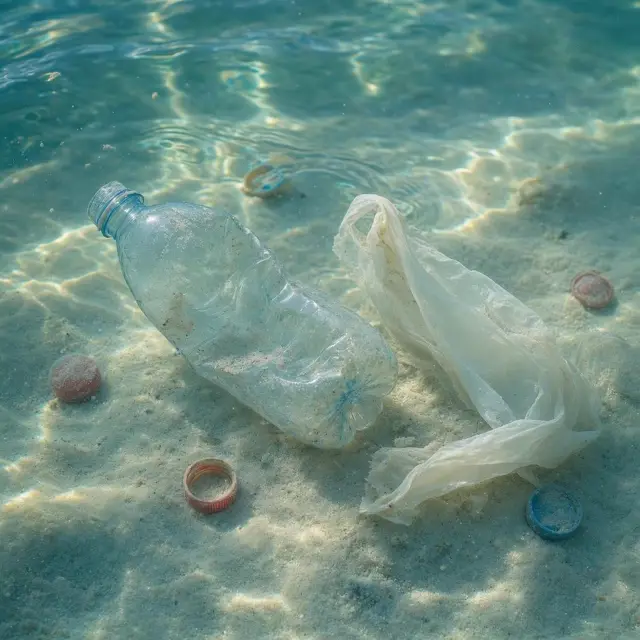
The same durability is the problem. Plastics break down extremely slowly in natural ecosystems, and most plastic ever produced has not been reused. Some of it simply cannot be. Much ends up in landfill or as pollution, and marine plastic pollution gathers into garbage patches at sea.
The recycling figure is the one that stings. Of all the plastic discarded so far, about 14% has been incinerated and less than 10% has been recycled. Particular concern now focuses on microplastics. Work is underway on a global treaty: in March 2022, UN member states voted to start negotiating a legally binding international agreement on plastic pollution.