A Machine Made of Raindrops
A rainbow is what happens when sunlight runs an obstacle course through falling water. Each droplet bends the incoming light (refraction), bounces it off its back wall (internal reflection), and splits it into colors (dispersion), because each wavelength bends at a slightly different angle.
The geometry is strict: the colored light exits droplets at 40 to 42 degrees from the direction opposite the sun, which is why rainbows always appear in the part of the sky facing away from it, with red on the outside and violet on the inside. It doesn't even need rain — mist, sea spray, waterfall spray, and airborne dew all work. And the record for persistence is absurd: a rainbow over Taiwan's Yangmingshan range in November 2017 lasted 8 hours and 58 minutes.
Yours and Yours Alone
Here is the quietly wonderful part: nobody else sees your rainbow. Every raindrop refracts and reflects sunlight the same way, but only light from a particular cone of droplets — aligned between the sun and *your* eyes — reaches you. The person beside you watches a different set of drops. Same sky, different rainbow.
This is also why you can never reach a rainbow's end: it isn't an object hanging in the sky but a relationship between sun, water, and observer, and it moves as you move. From the ground you see at most half the circle — but from an airplane, with the sun behind you and mist below, the rainbow closes into its true form: a complete ring. You can even conjure one yourself with a garden hose, standing with your back to the sun.
Double Bows and a Dark Band
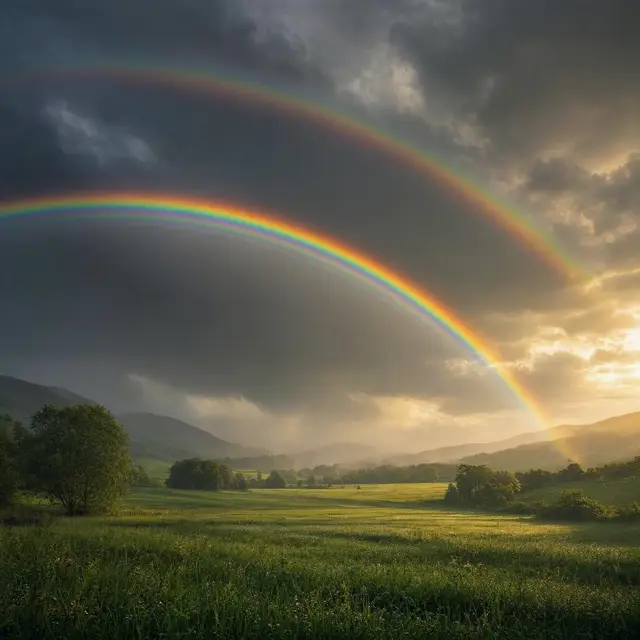
Sometimes a second, fainter arc appears about 10 degrees outside the first, its colors reversed — red inside, violet outside. That's a secondary rainbow, born from light reflecting *twice* inside each droplet; the extra bounce leaks light, which is why it's dimmer. Between the two bows the sky is noticeably darker — a gap called Alexander's band.
The family is bigger still. Supernumerary bows — delicate pastel fringes inside the main arc — arise from light waves interfering with each other, and their existence provided some of the first evidence that light is a wave. Moonbows arch through moonlit nights, looking white only because human eyes can't register color in dim light. Fogbows are ghostly pale rings in fog, and red-only rainbows can appear at sunrise and sunset, when the atmosphere strips away the shorter wavelengths.
Why Seven Colors? Blame Newton's Music Theory
Ask anyone how many colors a rainbow has and they'll say seven. That number isn't nature's — it's Isaac Newton's, who demonstrated that white light contains all the rainbow's colors and then chose seven names (red, orange, yellow, green, blue, indigo, violet) partly by analogy with the seven notes of a musical scale. In reality the rainbow is a smooth, continuous spectrum; the crisp bands are an artifact of human perception, and scholars note Newton's "indigo" would today just be called blue.
The explanation itself was centuries in the making: Theodoric of Freiberg gave an accurate account of both bows through refraction and reflection in 1307, René Descartes nailed the geometry in 1637, and Thomas Young's 1804 wave interference work explained the fringes Newton couldn't. Not bad for an object that, strictly speaking, exists only in the eye of its beholder.