The sailor's worst enemy
During the later Age of Sail, it was assumed that half the sailors on a major voyage of exploration would die of scurvy. In the 18th century, it killed more British sailors than enemy action did.
Scurvy is a deficiency disease caused by a lack of vitamin C. Long voyages kept crews away from land for months, living on a few basic foods with no fruit or vegetables. It takes at least a month with little or no vitamin C before symptoms show up.
First comes weakness, tiredness and sore arms and legs. Later, gums become diseased, teeth loosen, the skin bruises easily and wounds heal poorly. Mood changes can appear even before the physical signs. The good news is that the fix is simple. As little as 10 mg of vitamin C a day can treat it, and most people make a full recovery within two weeks.
Why humans can't make their own
Almost all animals and plants make their own vitamin C. Humans cannot. Our livers lack a working version of the enzyme needed for the last step. The same goes for monkeys and apes, tarsiers, guinea pigs, capybaras and some birds and fish. Lemurs and lorises, on the other hand, make their own.
The body needs vitamin C to build collagen, the main structural protein in blood vessels, skin, bone and muscle. Weak collagen means fragile tiny blood vessels, which explains the bruising, loose teeth and slow healing.
Science found this out partly by luck. In 1907, two Norwegian doctors, Axel Holst and Theodor Frølich, were studying a different disease in pigeons and wanted a small mammal instead. They chose guinea pigs, fed them grains and flour, and were surprised when the animals got scurvy. Until then, scurvy had been thought to affect only humans. Pigeons had never shown it because they make their own vitamin C.
Lind's test that nobody followed
Long before anyone knew about vitamins, sailors had clues. In 1601, Captain James Lancaster gave lemon juice to the crew of one of his four ships, while the other three got none. The untreated crews started getting scurvy.
In 1747, naval surgeon James Lind ran one of the first controlled clinical experiments in medical history aboard HMS Salisbury. He compared suggested cures side by side, including vinegar, seawater, a mixture that contained garlic, mustard seed and radish root, and oranges and lemons. His conclusion was clear: oranges and lemons worked best.
Then almost nothing happened. His results took up only a few paragraphs in a long, complicated book. Lind himself never pushed lemon juice as a single cure, because he believed scurvy had many causes. He even tried boiling lemon juice down into a concentrate, which destroyed the vitamin C. Leading doctors of the time thought scurvy was a digestion problem and recommended fizzy drinks instead.
Captain Cook's lucky wrong answer
When James Cook sailed around the world from 1768 to 1771, he was told to test malt and wort as scurvy cures. Sauerkraut was on the list too. Lemons were not.
Cook did not lose a single man to scurvy, and his report praised malt and wort. He was wrong about why. The real reasons were his strict rules on keeping the ship clean and his habit of restocking fresh food and greens often. He also banned a common navy habit of eating fat skimmed from the ship's copper cooking pans. The copper formed compounds that stopped the gut from absorbing vitamins.
The real turning point came in 1794. HMS Suffolk sailed for India fully stocked with lemon juice and sugar. It arrived in March 1795 after four months at sea without a trace of scurvy, and its crew was healthier than when it left. By June, the navy made lemon juice and sugar a daily ration on all warships.
The lime mix-up
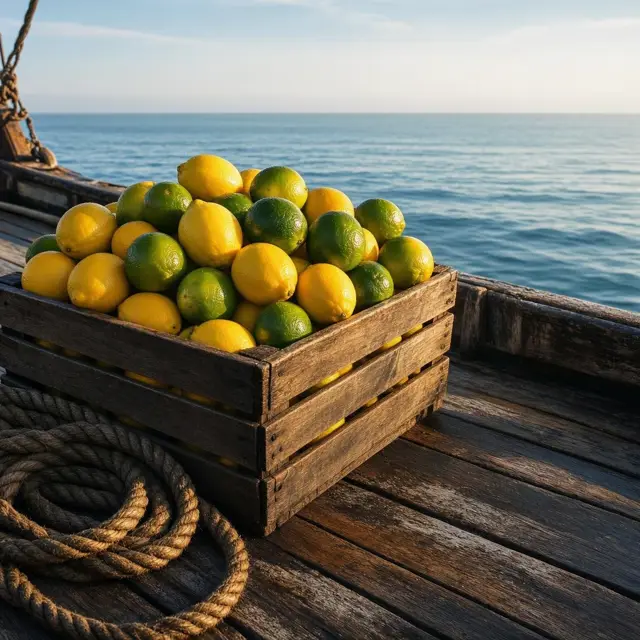
Then the navy made a switch that quietly undid much of the progress. It began using West Indian limes instead of Mediterranean lemons. Lemons had become hard to get during the Napoleonic Wars, while limes came easily from Britain's Caribbean colonies. Limes also seemed better because they were more acidic, and people believed the acid was the cure.
It was not. The limes had much less vitamin C than lemons. Worse, the juice was exposed to light and air and piped through copper tubing, which destroyed even more. A 1918 animal test of the navy's lime juice found it had almost no antiscorbutic power at all.
Still, the limes left a mark on language. An 1867 law required ships to give sailors a daily ration of lime or lemon juice, which led to the nickname limey for British sailors. Finally, in 1932, Charles Glen King proved that a compound called hexuronic acid was the missing factor. It was renamed ascorbic acid.