When a Ballot Was a Small Ball
For most of history, voting was a public act. People shouted their choices out loud, one at a time, at an assembly. Others raised their hands or walked to a certain spot in the room so they could be counted.
Some voters dropped small objects into a container instead, such as corn, pebbles, beans, colored marbles or cards. That habit gave us the word ballot, which originally meant "small ball". The word poll has a similar story. It first meant "top of the head", which is exactly what was counted at those gatherings.
In some places, voters even cut a brightly colored ballot out of a newspaper, with the color matching their party, and carried it to the polling place. Anyone watching knew exactly how they voted. The secret ballot changed that by keeping each voter's identity anonymous, which makes threats, blackmail and vote buying much harder to pull off.
Athens and Rome Tried It First
Hiding your vote is an old idea. In ancient Greece, secret ballots were used in several situations, including to stay hidden from people seeking favors. In Athens, secret voting entered public life during the second half of the fifth century BC. At first, secrecy was a side effect of counting votes more accurately.
Ancient Rome went further. Four laws, known as the Ballot Laws, brought secret voting to the major assemblies of the Roman Republic. Three arrived quickly, in 139 BC, 137 BC and 131 BC. They covered the election of officials, most jury decisions and the passing of laws. The fourth came in 107 BC and extended secrecy to every jury decision.
Before these laws, Romans had to tell their vote out loud to the person counting. That let rich aristocrats sway elections with bribes and threats. With a secret vote, nobody could prove how you had voted, so a bribe bought nothing certain.
The Australian Twist
The modern secret ballot is so linked to one country that it is often called the Australian ballot. Secret voting in Australia appears to have started in Tasmania on 7 February 1856. For a long time, though, the credit went to Victoria, where former Melbourne mayor William Nicholson pioneered it, and to South Australia at the same time. Victoria passed its secret ballot law on 19 March 1856, and Tasmania's original Electoral Act 1856 was only "re-discovered" recently.
Britain came later. A secret vote was one of the six demands of the Chartist movement. The London School Board election of 1870 became Britain's first large-scale secret election. Then the Ballot Act 1872 made secret voting general and greatly cut the cost of campaigning.
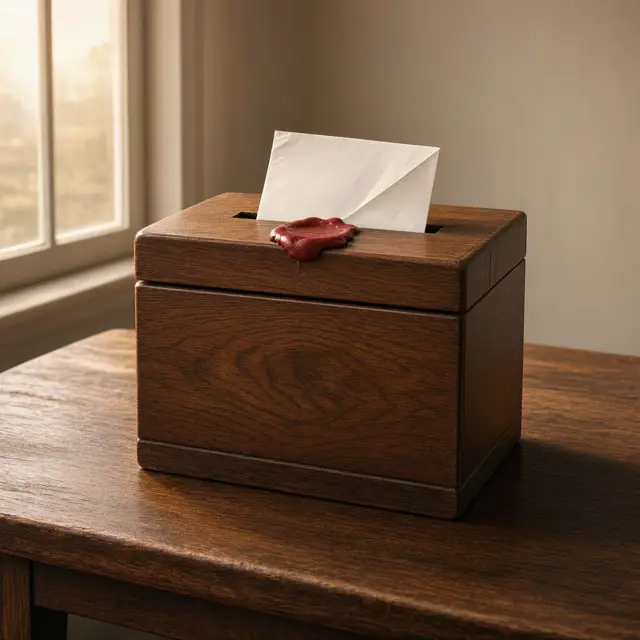
It was first used on 15 August 1872, in a by-election in Pontefract. The original ballot box, sealed in wax with a licorice stamp, is held at Pontefract museum.
How America Made the Switch
Before the late 1800s, American elections looked very different. Party newspapers printed ballots that were already filled out. Party workers handed them out on election day, and voters dropped them straight into the box. States began moving to secret ballots soon after the presidential election of 1884. Kentucky finished that wave in 1891, when it finally quit spoken votes. Oddly, the same state was home to Louisville, the first American city to adopt the Australian ballot.
A true Australian ballot needed four parts. It had to be printed at public expense, list the candidates of all parties, be handed out only at the polling place, and be marked in secret. Massachusetts adopted the first statewide version in 1888, so it is also called the "Massachusetts ballot".
Some states took decades longer. Georgia began using government-printed ballots in 1922. When South Carolina followed in 1950, the nationwide switch was finally complete.
Guarding the Secret Today
In Singapore, voters may not use electronic devices inside a polling station or take ballot papers out, and exit polls are illegal. After the election, the ballots go into a sealed box and are locked in a vault inside the Supreme Court for up to six months. Then they are taken to an incineration plant and destroyed.
In the United Kingdom, each ballot paper has a number, and each voter's number is written on its counterfoil. This helps spot fake ballots if fraud is claimed, but only an Election Court can order ballots matched to voters. Some American states print a number on a tear-off stub that goes on a ring, like a shower curtain ring. At the end of the day, stubs and ballots should match.
The voting booth matters too. France adopted it permanently only in 1913. A United Nations convention protects the right of disabled people to vote in secret, for example with Braille ballots.