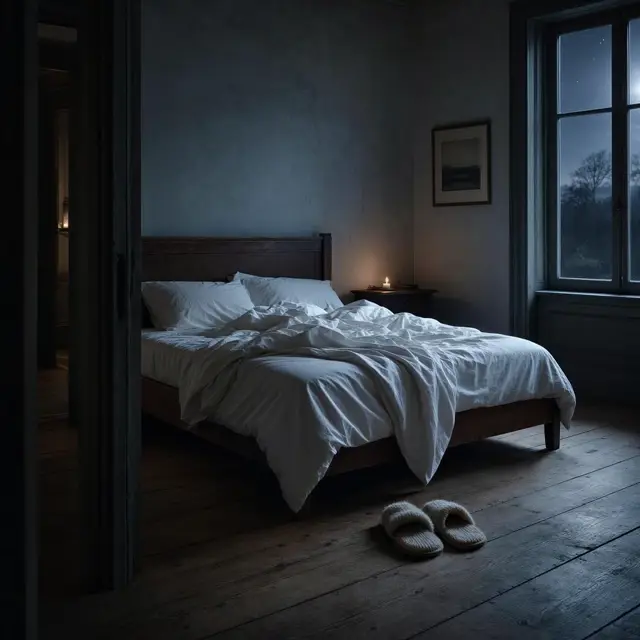
Eyes Open, Brain Half Asleep
Forget the classic cartoon of a sleepwalker with closed eyes and arms held out in front. Real sleepwalkers walk around with their eyes open. They just have a glassy stare, a blank look and wide pupils.
That odd look fits what is going on inside. Sleepwalking mixes sleep and wakefulness at the same time. Some parts of the brain act awake while others stay in very deep sleep. Experts call this a state dissociation. It belongs to a family of sleep disorders called parasomnia.
The sleeper can still find their way around, thanks to a mix of simple stumbling and habit. An episode can last anywhere from 30 seconds to 30 minutes. Afterward, most people remember little or nothing. Some keep vague memories, and a few can even tell a story about it. If they wake up mid-walk, they may be confused about how they got out of bed, but that fades within minutes.
Not Acting Out a Dream
For a long time, people assumed sleepwalkers were acting out their dreams. In 1954, a study from the Society for Science & the Public said just that. Twelve years later, the same group changed its mind. It wrote that sleepwalking "apparently has little to do with dreaming" and happens during the deepest, most unaware sleep.
Today we know sleepwalking happens during slow-wave sleep, the deepest part of non-REM sleep. That is why it usually shows up in the first third of the night, when this deep sleep is strongest. It tends to happen once a night, if at all.
Acting out dreams is a different problem, one that happens in REM sleep instead. Better sleep science came from new tools, like the EEG, invented by Hans Berger in 1924. Back in 1907, Sigmund Freud had also puzzled over sleepwalking. He was surprised that a person could move around without breaking their dream.
The Midnight To-Do List
What do sleepwalkers actually do? Often something simple, like sitting up in bed, talking, walking to the bathroom or cleaning. They may chat, but what they say usually makes no sense to anyone listening. Some go further, cooking or even driving a car, which can be risky.
Eating is another. There is even a named version, sleep-related eating disorder, where people eat without meaning to. They may eat normal meals or strange mixes of food. Many sleep eaters actually prepare what they eat. Because the snacks tend to be high in carbohydrates, weight gain is a common side effect.
The only accurate way to check an episode is a full overnight sleep study, called polysomnography. Because it costs a lot and episodes are rare, doctors usually rely on reports from the sleeper, a parent or a partner. Doctors use three main guides to diagnose it, including the ICD-11 and the DSM-5-TR.
Who Walks in the Night
Sleepwalking is much more common in kids. A review of 51 studies with more than 100,000 people found that about 5% of children had sleepwalked in the past year, compared with 1.5% of adults. Over a lifetime, somewhere between 4.6% and 10.3% of people do it at least once.
It seems to run in families. One study found that 45% of children sleepwalked if one parent did. That rose to 60% when both parents did. The exact cause is still unknown, but suspected triggers include lack of sleep, fever and being overly tired. Some medicines are linked to it too, with the best evidence for zolpidem and sodium oxybate.
People with migraines or Tourette syndrome are four to nine times more likely to sleepwalk. Hormones play a part as well. Pregnancy seems to make episodes less likely. And as of 2002, sleepwalking had never been seen in non-human primates. Nobody knows yet if it is simply unobserved, or a uniquely human habit.
Safety Tips and Stage Stars
Is it dangerous to wake a sleepwalker? There is no evidence either way. The person will most likely just be confused for a bit. No treatment has been proven in clinical trials. If sleepwalking causes no problems, doctors simply offer reassurance. When it does, hypnosis and scheduled waking are the recommended options.
Simple safety steps help. A door alarm can wake the sleeper, or alert the people they live with. Sleepwalkers are advised to sleep on the ground floor where they can.
Sleepwalking has also inspired famous art. In Vincenzo Bellini's 1831 opera La sonnambula, a young woman named Amina is wrongly suspected after she is found in a stranger's room. The truth comes out when her fiancé sees her sleepwalking across a very high and very rickety bridge at the local mill. The sleepwalking scene in Shakespeare's Macbeth is one of the most famous scenes in all of literature.