Not Poison. Demolition.
Most people assume soap is a mild disinfectant that kills germs chemically. What actually happens is closer to structural collapse.
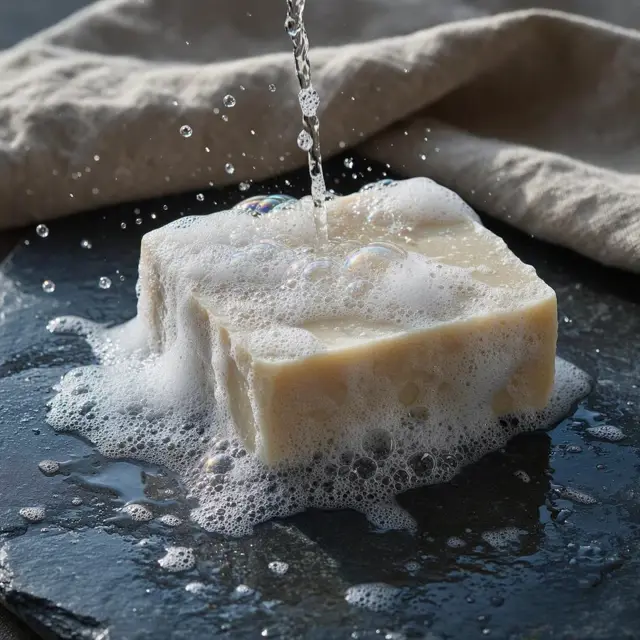
Soap is a surfactant. When you lather it with a little water, its molecules pull apart a microorganism's outer lipid bilayer, the fatty envelope holding it together, and denature its proteins. The germ does not get poisoned. It comes apart.
The second job is hauling the wreckage away. Soap molecules have a water-loving head and a fat-loving tail, so they cluster into tiny spheres called micelles, with the water-attracting groups facing outward and a fat-attracting pocket hidden inside. Grease and grime get trapped in those pockets, shielded from the surrounding water, which makes the whole package soluble. Anything soluble goes down the drain with the rinse. This is also why scrubbing time matters more than any spray: the mechanism is mechanical.
The Oldest Written Chemistry
Soap-like materials go back roughly 4,800 years. The earliest recorded evidence of producing them dates to around 2800 BC in ancient Babylon, and proto-soaps are mentioned in Sumerian, Babylonian and Egyptian texts.
A formula was written on a Sumerian clay tablet around 2500 BC: heat a mixture of oil and wood ash. That tablet is the earliest recorded chemical reaction of any kind, and the product was used for washing woollen clothing rather than people.
Egypt had its own version. The Ebers papyrus of 1550 BC indicates that Egyptians combined animal fats or vegetable oils with a soda ash substance called trona, using the result as a medicine as well as in preparing wool for weaving. From the reign of Nabonidus in the 6th century BC comes a recipe of ashes, cypress oil and sesame oil, recorded specifically "for washing the stones for the servant girls".
The Romans Scraped Instead
For a civilisation famous for its baths, Rome was oddly late to soap. The Romans did not use it until at least the first century AD.
Their preferred method of cleaning the body was to massage oil into the skin and then scrape it off, along with the dirt, using a strigil: a curved metal blade with a handle. Effective, but not soap.
When soap does appear in Roman writing, it arrives as a foreign import. Pliny the Elder describes it as "an invention of the Gauls", and records its manufacture from tallow and ashes, noting it was used to treat sores and, among the Gauls, as a dye to redden hair. The Latin word *sapo* has long been linked to a mythical Mount Sapo where animals were sacrificed, but in all likelihood it was simply borrowed from an early Germanic language. The Romans avoided harsh soaps until they encountered the milder Gaulish ones around 58 BC.
What Is Actually in the Bar
Making toilet soap means saponification: treating fats or oils, chemically known as triglycerides, with an alkaline solution, usually lye. The fats break into salts of fatty acids, and glycerol is set free. Leave the glycerol in and the soap is softer and more moisturising; take it out and you can sell it separately.
The alkali decides the texture. Sodium hydroxide gives firm bar soaps, potassium hydroxide gives soft or liquid ones, and lithium soaps come out hard enough that they are used almost exclusively in industrial greases rather than on skin.
The fat decides the feel. Coconut, olive, palm and tallow each carry different fatty acids, so each produces a distinctly different soap. Soap made from pure olive oil, known as Castile or Marseille soap, is prized for mildness. Most body soaps are also "superfatted", carrying extra fat that guarantees no leftover lye, stops bars cracking, and replaces the skin oils that the washing just stripped away.