A Tiny Boom in Your Hands
Snap a rolled-up towel and you have made a tiny sonic boom. The crack of a bullwhip is one too. The tip of the whip, called the cracker, moves faster than the speed of sound, and that burst of speed makes the bang.
A whip gets thinner from the handle to the tip, and the tip has much less mass. When you swing it hard, the motion travels down the whip. As the mass shrinks, the speed goes up to make up for it. Researchers Goriely and McMillen showed that the full physics is complex, involving a loop that travels down a tapered line under tension.
Now scale that up to a supersonic plane. Booms from large supersonic aircraft can be loud and startling. They tend to wake people up and can cause minor damage to some buildings. That is why routine supersonic flight over land was banned.
How Squeezed Air Turns Into a Bang
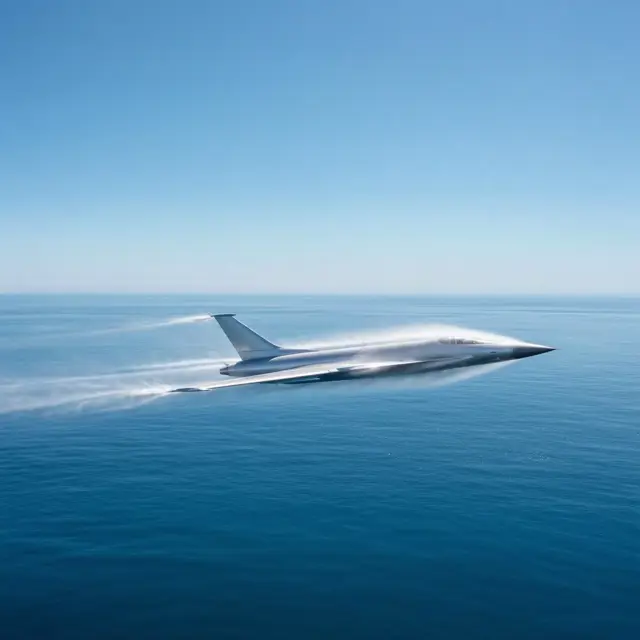
A plane pushes through the air and makes pressure waves in front of it and behind it, a bit like the waves at the front and back of a boat. These waves travel at the speed of sound. As the plane speeds up, the waves pile into each other, because they cannot get out of each other's way fast enough.
Finally they merge into a single shock wave. The critical speed is called Mach 1, about 1,192 km/h (741 mph) at sea level and 20 °C. The shock wave spreads out behind the plane as a Mach cone, with the aircraft at its tip. The faster the plane flies, the thinner and pointier the cone gets.
The pressure jumps up at the nose, drops below normal at the tail, then snaps back to normal once the plane has passed. On a graph it looks like the letter N, so it is called an N-wave. Each sudden jump makes a bang, which is why supersonic jets are known for a double boom.
The Boom That Follows You Everywhere
Many people think a plane makes one boom at the moment it breaks the sound barrier. That is a common mistake. The boom keeps going for as long as the plane flies faster than sound. It only reaches people standing where the cone behind the plane sweeps over them.
On the ground, this leaves a strip of noise under the flight path, like a red carpet unrolling behind the plane. Engineers call it the boom carpet. It is roughly 1 mile wide for every 1,000 feet of altitude, so a jet flying supersonic at 30,000 feet spreads its boom across about 30 miles. The boom lands 2 to 60 seconds after the plane passes and lasts less than a second.
The people on board hear nothing at all. A former Concorde pilot said the crew only saw the pressure wave move down the plane on their instruments, around Mach 1. He compared the boom to the wake of a ship: it is always behind you.
Record Booms and Angry Towns
Booms are measured by their overpressure. Today's supersonic aircraft usually produce anywhere from under 50 to 500 Pa on the ground. The strongest boom ever recorded hit 7,000 Pa. It came from an F-4 flying just above the speed of sound at only 100 feet, and the researchers exposed to it were not hurt.
Real towns have felt the noise too. In 1964, NASA and the Federal Aviation Administration began the Oklahoma City sonic boom tests, with eight booms a day for six months. The tests gathered useful data, but they also drew 15,000 complaints and a class-action lawsuit, which the government lost on appeal in 1969.
In the UK, North Cornwall and North Devon sat under Concorde's route across the Atlantic. Windows rattled, and sometimes the mortar under roof slates shook loose. The ground itself matters as well. Grassy fields and thick plants soften a boom, while concrete and large buildings can bounce it back and make it louder.
The Race to Build a Quiet Supersonic Jet
In the late 1950s, designers thought flying higher would solve the problem. The North American XB-70 Valkyrie proved them wrong, because its boom was still a problem at 70,000 feet. Researchers at Cornell University later created a score for boom levels, where about 1 or lower was acceptable. Concorde scored about 1.4. Public anger and new laws, such as flying supersonic only over water, doomed most of these airliner projects.
The answer turned out to be shape. A modified F-5 called the Shaped Sonic Boom Demonstration flew 21 test flights and cut the boom by about one-third. In 2018, NASA gave Lockheed Martin a $247.5 million contract to build the X-59, a plane meant to shrink the boom to the sound of a car door closing. It first flew on 28 October 2025.
Boom Technology is betting on a different trick called Mach cutoff, where the shock wave from a plane flying at low supersonic speeds never reaches the ground. In January 2025, its XB-1 test plane broke the sound barrier, the first private aircraft in history to do so. Microphones on the ground under its path detected no boom at all.