A Beeping Ball Starts the Race
The first satellite was launched early partly because of a misunderstanding. Soviet rocket designer Sergei Korolev heard about an American Jupiter-C rocket test in 1956 and wrongly thought it was a failed satellite attempt. He sped up his own plans. He also dropped a heavy, instrument-packed design and went for a much simpler one.
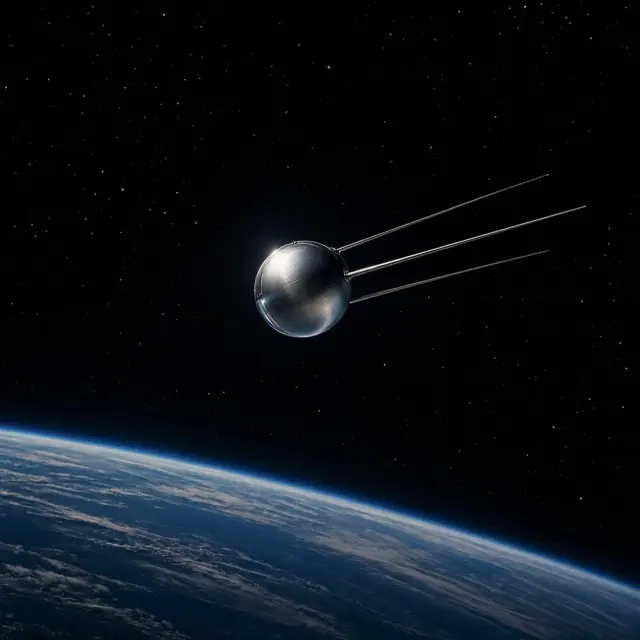
The result was Sputnik 1, a metal sphere just 58 centimeters across and weighing 83.8 kilograms. It carried two radio transmitters and not much else. It lifted off on October 4, 1957, at 10:28:34 pm Moscow time. The team only truly celebrated about 95 minutes later, when the satellite flew back over the launch site still sending its famous beep, beep, beep.
The name means "fellow traveler" in English. The contest itself had started two years earlier, on July 29, 1955, when the United States announced plans to launch satellites for the International Geophysical Year. Five days later, the Soviet Union said it would launch one too.
Science Fiction Became a Plan
Public excitement came before the rockets. In October 1951, Soviet engineer Mikhail Tikhonravov wrote "Flight to the Moon" for a newspaper for young readers. He described a two-person spaceship and predicted the dream would come true within 10 to 15 years. From 1952 to 1954, the US magazine Collier's answered with seven articles on Wernher von Braun's plans for crewed flight. In 1955, a Disneyland TV episode called "Man in Space" reached about 40 million viewers.
Then the real firsts arrived fast. On January 31, 1958, the US launched Explorer 1. Its radiation counter kept filling up, which proved that Earth is wrapped in a doughnut-shaped zone of strong radiation, now called the Van Allen radiation belt. That July, NASA was created as a civilian space agency.
The Soviet Luna probes aimed at the Moon. Luna 2 hit it in September 1959, and a month later Luna 3 sent back the first pictures of its far side.
The First People in Space
On April 12, 1961, Yuri Gagarin circled Earth once in Vostok 1, a trip of 108 minutes. The capsule flew itself, because doctors did not know how weightlessness would affect a person. Gagarin was given a sealed envelope with a code to unlock manual control in an emergency. April 12 is now the International Day of Human Space Flight.
The Soviets kept their capsule's real look secret for years. When they showed the Vostok rocket in 1961, they added a tail with eight fins, apparently to confuse Western observers. The true capsule was only revealed in 1965.
The Americans answered quickly. On May 5, 1961, Alan Shepard became the first American in space and the first person to steer his own spacecraft. John Glenn orbited Earth three times in February 1962. In June 1963, Valentina Tereshkova became the first woman in space. In March 1965, Alexei Leonov made the first spacewalk. His suit puffed up so much that he had to let some air out to squeeze back inside.
The Race to the Moon
On May 25, 1961, President John F. Kennedy asked Congress to commit to "landing a man on the Moon and returning him safely to the Earth" before the decade ended. The Soviet leadership publicly said nothing. In secret, it ran two competing Moon programs.
NASA's Gemini missions practiced the skills a Moon trip needed. Gemini 6A and Gemini 7 flew as close as 1 foot apart, a feat called a rendezvous. Then on July 20, 1969, Apollo 11 landed. About 723 million people, at least one-fifth of humanity, watched Neil Armstrong's first step live. The mission finished with 161 days to spare before Kennedy's deadline.
There was a surprise neighbor in lunar orbit. The Soviet Luna 15 probe had arrived just before Apollo 11. To avoid a collision, the Soviet Union shared its flight plan, one of the first examples of space talk between the two sides. Luna 15 then tried a robot landing to scoop up Moon samples, just two hours before Apollo 11 lifted off. A British astronomer tracking it called it "drama of the highest order."
Robots, Venus and a Handshake
The race did not stop at footprints. In 1970, Luna 16 became the first robot probe to bring Moon soil back to Earth. That same year, the Soviets landed the first robotic rover on the Moon, the Lunokhod. They also turned to Venus. Venera 7 became the first spacecraft to send data from the surface of another planet, reading 475 C and a crushing 92 bar of pressure. In 1981, Venera 13 sent the first color photos of the Venusian ground and even recorded its sound.
Then rivals became partners. After the leaders agreed to ease tensions in 1972, a period called détente, the two sides planned a joint flight. In July 1975, an Apollo and a Soyuz docked in orbit. The crews shook hands, swapped gifts and visited each other's craft.
That teamwork grew into the International Space Station. From 2011 to 2020, American crews even rode Russian Soyuz spacecraft to get there. Historians still debate who "won" the Space Race.