Tougher Than Steel and Kevlar
Weight for weight, spider silk is stronger than steel. It is not as strong as Kevlar, but it is tougher than both. Strength and toughness sound alike, but they are different things. Strength is how hard you can pull a thread, while toughness is how much energy it soaks up before it snaps.
The star of the show is dragline silk, the thread a spider hangs from. Its tensile strength is close to that of high-grade alloy steel. Yet silk is only about a sixth as dense as steel. A strand long enough to circle the Earth would weigh about 2 kilograms. Some silks can also stretch up to five times their relaxed length without breaking.
The record holder is Darwin's bark spider. Its silk is more than twice as tough as any silk described before it, and over 10 times tougher than Kevlar. Dragline silk also keeps its strength from below -40 °C up to 220 °C.
Seven Silks From One Spider
All spiders make silk, even the ones that never build webs. A single spider can produce up to seven different types of silk. Insects that make silk usually manage just one type. Each kind of spider silk comes from its own gland, so scientists can link a silk to its job.
Those jobs are surprisingly varied. Silk builds homes and web frames, wraps up prey, protects eggs and carries vibrations to the spider. Fine thread lets spiders float through the air, a trick called ballooning. Another strand works as a safety line, letting a spider drop down from a height.
The garden cross spider shows how busy this gets. An adult has about 500 glands just for attachment points and 300 for egg sac linings and wrapping prey. Smaller sets handle web frames and glue. Webs have changed over time too, from simple tube webs 300-400 million years ago to complex orb webs 110 million years ago.
Spinning With No Spin at All
The word spinning is misleading, because nothing rotates. Silk is actually pulled out of the body, either by the spider's legs or simply by its own weight as it falls. This is called pultrusion. It is like squeezing something out of a tube, except the force comes from tugging the finished end.
Inside the spider, silk starts as a gel-like liquid called silk dope, kept in a storage sac. It flows into a narrow, twisting duct. There, cells remove water and make the liquid acidic. The squeeze and the chemistry turn the liquid into a solid, highly ordered fibre. It finally leaves through a spinneret, and spiders have two to eight of them.
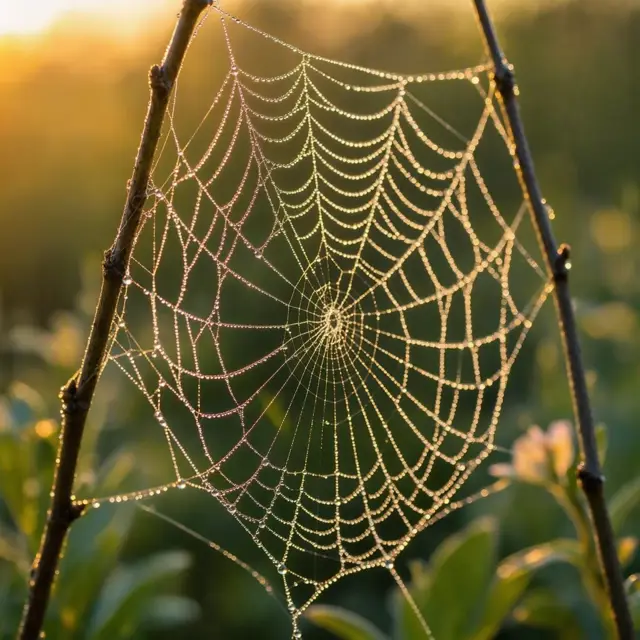
The finished silk comes with clever extras. Its acidity protects it from fungi and bacteria. And when dragline silk gets wet, it can shrink by up to 50 percent. A popular idea is that this supercontraction helps tighten webs built at night, using the morning dew.
Silk From Goats, Yeast and Bacteria
Collecting silk from lots of spiders is much harder than collecting it from silkworms. So scientists borrow other living things. In March 2010, researchers in Korea made spider silk using E. coli bacteria given genes from a spider. That removed the need to milk spiders at all.
Other teams got even more creative. A Canadian company made goats whose milk held 1-2 grams of silk protein per litre. Another company used yeast to make a recombinant silk protein and sold the first clothes made from it, ties and beanies. In 2016, a ski parka made from synthetic spider silk was being tested.
Copying the spider is still hard. Lab-made fibres come out 10 to 60 micrometres wide, compared with 2.5 to 4 for natural silk. They also have about half the strength and flexibility of real dragline silk. Researchers at Japan's RIKEN built an artificial gland that pulls the liquid rather than pushing it, and its fibres matched the natural structure.
Gloves, Golden Cloth and Violin Strings
People have tried to wear spider silk for centuries. In 1709, François Xavier Bon wove silk from spider egg cocoons into stockings and gloves. About fifty years later, Ramón M. Termeyer invented a device to reel silk straight from spiders. Neither man managed to make enough to sell.
The largest known piece of spider silk cloth shows why. Made in Madagascar in 2009, it measures 11 by 4 feet and has a golden tint. Eighty-two people worked for four years to collect over one million golden orb spiders and draw silk from them. In 2012, spider silk fibres were even turned into a set of violin strings.
In science, silk has served as the fine crosshairs inside telescopes and microscopes. It has also held tiny fusion fuel targets in place during laser experiments. It stays stretchy even at extremely cold temperatures, and it is made of light elements that give off no x-rays that could heat the target too early.