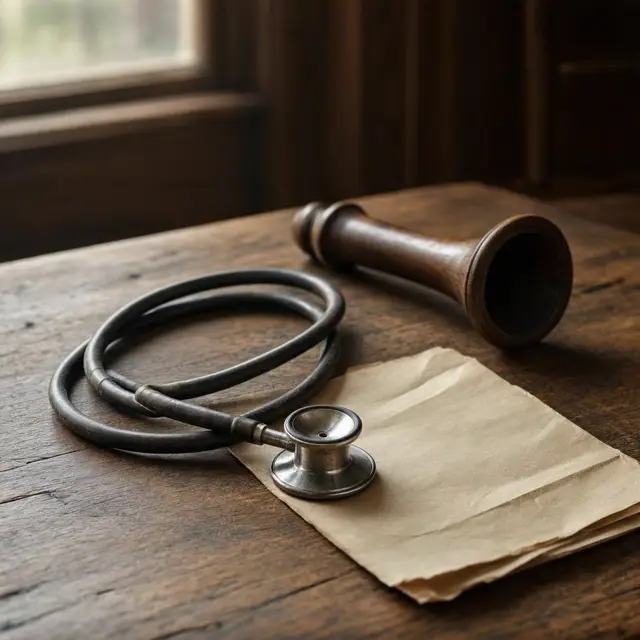
A Rolled Up Sheet of Paper
Before 1816, a doctor who wanted to hear a patient's heart put an ear directly on the chest. Rene Laennec, working at the Necker-Enfants Malades Hospital in Paris, was not comfortable doing that with a woman patient.
His way around it turned out to be better medicine, not just better manners. He noticed that a rolled up piece of paper held between the chest and his ear made the heart sounds louder rather than fainter. He built a wooden tube on the same idea, with a single earpiece, and named it the stethoscope from the Greek words for chest and to look at.
He called the technique mediate auscultation, because he was listening through something placed between the patient and himself. His device was almost identical in shape and function to the ear trumpet people used as a hearing aid. Today auscultation simply means listening to the sounds inside a body.
Two Ears Are Better Than One
Laennec's tube had one earpiece. The version everyone pictures today came later, from a few people working separately.
In 1840, Golding Bird described a stethoscope with a flexible tube, still with a single earpiece, and was the first to publish such a design. In 1851, the Irish physician Arthur Leared built a binaural instrument, one that fed sound to both ears. The following year, George Philip Cammann, a doctor in New York, refined that design for commercial manufacture, giving it a plug for each ear.
Cammann's version has essentially not changed since. Improvements have been made to materials and shape, but the basic instrument a doctor hangs around their neck today is his. He also wrote a major treatise on diagnosing by listening, which his own refined instrument had made possible.
The Bell and the Diaphragm
An acoustic stethoscope has no electronics at all. Sound travels from the chest piece through air filled tubes to the listener's ears, and the whole thing works on physics that has not changed in a century.
The chest piece usually has two sides. One is the diaphragm, a flat plastic disc that vibrates when body sounds hit it and pushes pressure waves up the tube. The other is the bell, a hollow cup that picks up vibrations from the skin directly. They are not interchangeable: the bell carries low frequency sounds and the diaphragm carries higher ones. Rotating the tube by 180 degrees switches between them. This two sided design came from Rappaport and Sprague early in the 20th century.
Electronic versions amplify body sounds instead, and some can record, reduce background noise or send heart sounds to a phone. A fetal stethoscope, shaped like a listening trumpet, is placed on a pregnant woman's abdomen to hear the baby's heartbeat.
A Symbol That Is Slowly Losing Ground
The stethoscope is the visual shorthand for medicine. A 2012 research paper found that of all medical equipment, it had the greatest positive effect on how trustworthy a practitioner appeared to be.
Its actual use tells a more complicated story. Studies show that skill at auscultation, meaning the ability to reach a diagnosis from what is heard through the instrument, has been declining for some time, and some medical educators are now working to rebuild it.
Other jobs it used to do are being handed off. Measuring blood pressure the traditional way meant an inflatable cuff, a mechanical gauge and a stethoscope to listen for the sounds in the artery. In general practice, automated monitors are steadily replacing that routine.
How useful the instrument remains depends a great deal on the speciality, and opinions among doctors differ sharply.