When a Word Tastes Like Waffles
For some people, hearing the word basketball fills their mouth with the taste of waffles. Pub owner James Wannerton tastes something every time he hears a name, which is how a documentary about him got its title: Derek Tastes of Earwax.
This is synesthesia. It happens when one sense or way of thinking sets off an automatic experience in another. Letters can have colors, sounds can have shapes, and dates can sit in fixed spots in the air. The name comes from Ancient Greek words meaning together and sensation. People who have it are called synesthetes, and there are at least 80 known types.
The earliest recorded case goes back to 1690, when John Locke described a blind man who said he experienced the color scarlet when he heard a trumpet. Experts still argue whether Locke meant it literally or as a figure of speech. The first medical account came in 1812, from the German physician Georg Tobias Ludwig Sachs.
Red Letters and Firework Music
In one of the most common forms, each letter and number arrives already tinted with a color. Letters and numbers are known together as graphemes. Different people usually report different colors, but patterns show up across large groups. A tends to be red, O tends to be white or black, and S is often yellow.
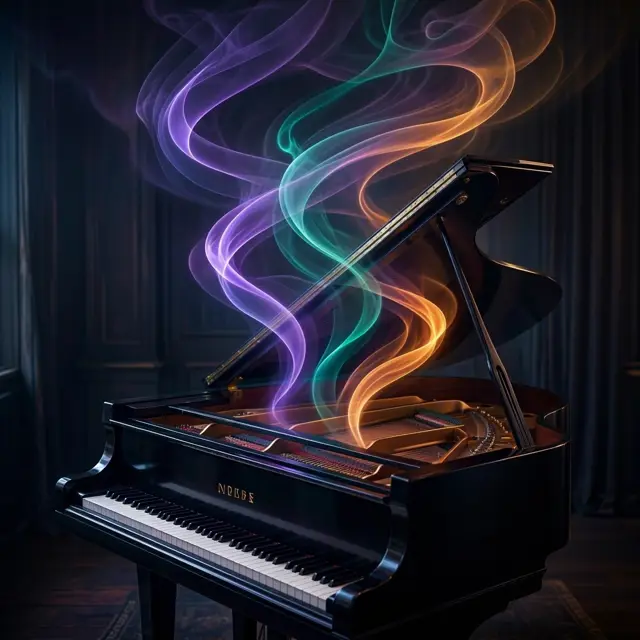
In chromesthesia, sounds bring colors. Neurologist Richard Cytowic compared it to fireworks: voices, music, even clattering dishes or a barking dog set off colored shapes that rise, move around and fade when the sound stops. Some people see music on a kind of screen in front of their face. Some synesthetes see a trumpet as an orange triangle floating in space, while others simply feel strongly that it sounds orange.
One of the strangest cases involved a man who was color blind. He could not see certain colors with his eyes, yet he saw them when looking at certain letters. With no names for them, he called them Martian colors.
Calendars in the Air
Some synesthetes see time laid out in space. For them, 1980 may feel farther away than 1990, and the months may wrap around them like a giant clock. A mental map of numbers like this is called a number form. Francis Galton first described and named number forms in 1881.
This can be handy. A study at the University of Edinburgh found that people with this kind of synesthesia have a built-in memory aid. Where most people need a trick to remember dates, they can simply look at their mental map. Some synesthetes also give numbers, letters and weekdays their own personalities or genders.
Other forms are just as odd. People with mirror-touch synesthesia feel a tap on their own shoulder when they watch someone else get tapped. People with ticker-tape synesthesia see spoken words written out in their mind, as if life came with subtitles.
How Scientists Know It Is Real
The simplest test is to ask again, years later. People pick colors for letters or sounds, sometimes from a screen offering 16.7 million choices. Synesthetes match their earlier answers about 90% of the time, even years apart. Non-synesthetes score only 30 to 40%, even with a few weeks' gap and a warning they would be retested.
In one study of 500 people from Edinburgh and Glasgow, 4.4% turned out to have some form of synesthesia. Colored letters and numbers showed up in more than one percent. Many synesthetes grow up thinking everyone sees the world this way. Others say it felt like keeping a secret their whole lives. It often runs in families, and most synesthetes call it pleasant or neutral.
Everyone has a little of it, too. In the bouba/kiki effect, people are shown a spiky shape and a rounded one. Between 95 and 98% name the spiky one kiki and the round one bouba, and even 2.5-year-old children do the same.
Musicians Who See Sound
Music has plenty of synesthetes. Composer Olivier Messiaen invented a new way of composing to capture how he linked sound and color. His piece From the Canyons to the Stars paints the red rocks of Bryce Canyon in sound. Duke Ellington and Jean Sibelius also reported the trait.
Ramin Djawadi, who wrote the music for Game of Thrones, says he tends to associate colors with music. British composer Daniel Liam Glyn made an album called Changing Stations with one track for each of the 11 main London Underground lines, each written in the key that matched that line's color for him.
Pharrell Williams based the album Seeing Sounds on his synesthesia. Billie Eilish, Lorde and Billy Joel are also on the list of known synesthetes. The singer Marina and the Diamonds hears music in color and says even the days of the week have their own colors.