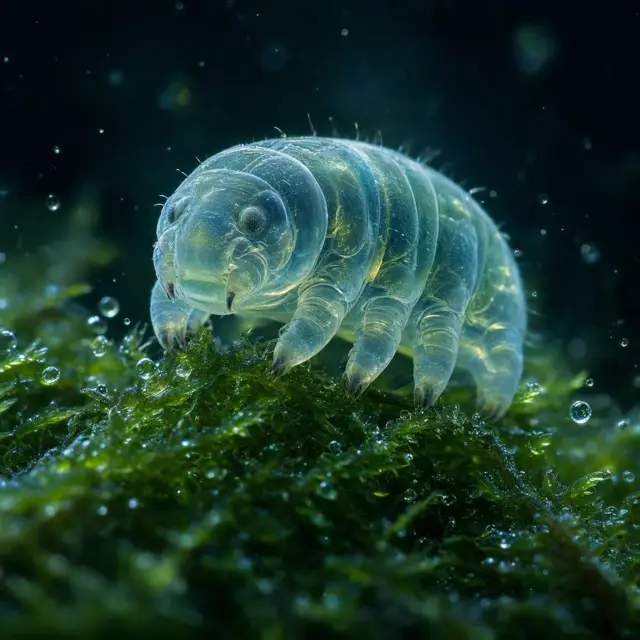
Little Water Bears
Tardigrades are tiny animals with eight legs and a short, plump body. Most are between 0.05 and 0.5 millimetres long, so you need a microscope to see them properly. Each leg ends in claws or sticky pads.
They got their cute nickname early. In 1773, the German zoologist Johann August Ephraim Goeze called them little water bears, because of the clumsy, bear-like way they walk. Three years later, the Italian biologist Lazzaro Spallanzani gave them the scientific name Tardigrada, meaning slow walkers.
They live almost everywhere: mountaintops, the deep sea, tropical rainforests and Antarctica. Most live in damp places such as moss, lichens, soil and fallen leaves. On moss, there can be more than 2 million of them in a single square metre.
Their bodies are simple in surprising ways. They have no lungs, no gills and no blood vessels. Instead, gases pass straight through their tough outer covering, the cuticle, which they shed as they grow.
The Art of Playing Dead
The tardigrade's greatest trick is shutting its body down almost completely. When the moss or pond it lives in dries out, it pulls in its legs and dries itself into a shrivelled shape called a tun. In this state, known as cryptobiosis, all activity inside its body stops.
A tun can go without food or water for several years. When water returns, the tardigrade can come back to life.
Dried out like this, a tardigrade becomes astonishingly tough. Tuns have survived temperatures from as low as −272 °C to as high as 149 °C, at least for short periods. They can also cope with a lack of oxygen, a vacuum, crushing pressure and ionising radiation.
They can even survive a violent hit. In experiments, tardigrades have lived through impacts at speeds of about 900 metres per second, and sudden shock pressures of about 1.14 gigapascals.
Scientists point out that tardigrades do not actually thrive in these extreme conditions. They simply endure them, and the longer they are exposed, the more likely they are to die.
Space Travellers
Tardigrades have been to space and back. In 2007, dried tardigrades and their eggs flew on a mission called FOTON-M3 and were exposed to space for 10 days. The vacuum alone had no real effect on them. Harsh ultraviolet light from the Sun was another story and killed many, but some still revived when scientists added water back on Earth.
In 2011, tardigrades travelled to the International Space Station, showing they could cope with microgravity and cosmic radiation. Scientists now see them as a useful animal for studying how life handles space.
Then came their most unusual journey. In 2019, a capsule holding dried tardigrades was on board Beresheet, an Israeli spacecraft that crashed on the Moon.
Their toughness has made them famous far beyond science. Tardigrades now appear in science fiction, and on clothing, statues, soft toys and even crochet patterns. They are easy to find in moss and view with a simple microscope, which makes them popular with students and amateur scientists.
The Secret Proteins
For a long time, scientists thought tardigrades survived drying out thanks to a sugar called trehalose, which helps many other hardy creatures. But tardigrades do not make enough of it.
Instead, they rely on special proteins. When they start drying out, they produce proteins that have no fixed shape. Three kinds are found only in tardigrades. They may protect the thin outer layer of each cell, and may form a glass-like layer that keeps the inside of cells safe.
Their DNA has its own shield, too. A protein called Dsup, short for damage suppressor, attaches to DNA and helps protect it from radiation damage.
These proteins have caught the attention of medical researchers, who see potential in their ability to protect living tissue from damage and drying out.
Tardigrades are also ancient. Their earliest known fossils come from the Cambrian period, about 500 million years ago, and there are around 1,500 known species today.