Older Than Coins, Older Than Writing About Anything Else
The first known system of taxation was in Ancient Egypt, around 3000 to 2800 BC, in the First Dynasty of the Old Kingdom. Tax is about as old as organised government, because in a real sense it is what organised government is.
The two earliest and most widespread forms were the corvée and the tithe. The corvée was forced labour given to the state by peasants too poor to pay in anything else, and the language makes the link explicit: in ancient Egyptian, the word for labour is a synonym for taxes. If you had no grain, you paid in days of your life.
The tithe was collected in person, and at scale. Records from the period describe the Pharaoh making a tour of the kingdom every two years, collecting tithes from the people as he went.
Early taxation also appears in the Bible, in ancient Vedic texts, in the Bronze Age Hittite Empire and in the Persian Empire.
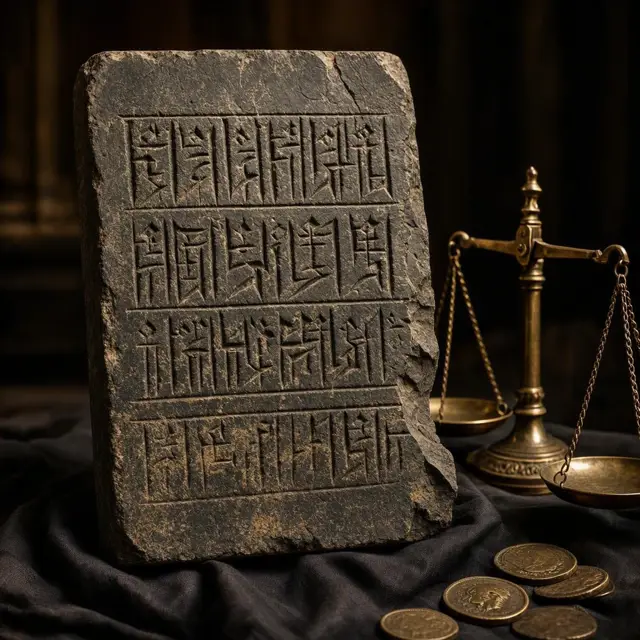
The Rosetta Stone Is a Tax Document
Here is a fact that quietly rearranges a famous object. The Rosetta Stone is the artefact whose decipherment unlocked our modern understanding of hieroglyphs, and it is the reason we can read ancient Egypt at all.
It is a decree issued by Ptolemy V, and what it contains is tax concessions.
Think about what that means. The single most important key to an entire civilisation's written language survived because a government wanted to publicise a tax break widely enough, and permanently enough, to carve it in stone in three scripts.
It is a useful corrective to how we imagine the ancient world. The writing that lasts is rarely poetry. It is receipts, ledgers, grain counts and tax rulings, because those are the documents states care enough about to make durable.
Rome Outsourced Collection, Then Regretted It
In the Roman Republic, individuals were taxed at between 1% and 3% of the assessed value of their total property. Collecting it was so difficult that the government auctioned the job off every year.
The winners were tax farmers, known as publicani. They paid the government the expected revenue up front, then kept whatever they collected from individuals. They handed over coin but collected in other forms of exchange, which conveniently spared the state the work of currency conversion. In effect the arrangement worked as a loan to the government, on which it paid interest.
Profitable for everyone involved, except arguably the people being collected from. It was eventually replaced under the emperor Augustus with direct taxation: each province owed 1% on wealth plus a flat rate on every adult.
That reform had a side effect that outlived the tax itself. It required regular census taking, and it shifted the whole system toward taxing income rather than wealth.
What Tax Actually Does, and Where It Goes to Hide
A tax is a compulsory charge imposed by a government on a person or an organisation, either to fund public spending or to steer behaviour by making certain activities more expensive.
In economic terms it moves wealth from households and businesses to the state, and the effect on growth can run either way. Spending that money can amplify economic activity, an effect called the fiscal multiplier, while the distortions taxation introduces can also drag on it, known as the excess burden of taxation.
History is full of discarded methods. Obsolete forms include seigniorage, the tax taken on the creation of money itself before fiat banking, and scutage, paid instead of performing military service.
And there is the modern escape route. Some countries, usually small ones with lower infrastructure and social costs, act as tax havens by charging minimal tax on personal and corporate income. They pull in capital from larger economies, which lose the revenue in turn.