The Moon Is Drifting Away, One Tide at a Time
Tides do more than wet the beach. They are slowly pushing the Moon away from Earth, by about 3.8 centimetres every year. At the same time, they are putting the brakes on our planet's spin. Over the last 600 million years, the day has grown longer by about 2 hours.
The cause is friction. As tides slosh around ocean basins, big flows break down into smaller swirling flows that lose energy. Earth's tides lose energy at an average rate of about 3.75 terawatts, and about 98% of that loss happens in the oceans. This drag passes angular momentum to the Moon's orbit, so the Moon slowly moves farther out.
The same drag pushes back on Earth and slows its rotation. If the slowdown had stayed steady, which is only a rough guess, then 70 million years ago the day was about 1% shorter. A year back then would have had about 4 more days in it.
Why the Sea Rises Twice a Day
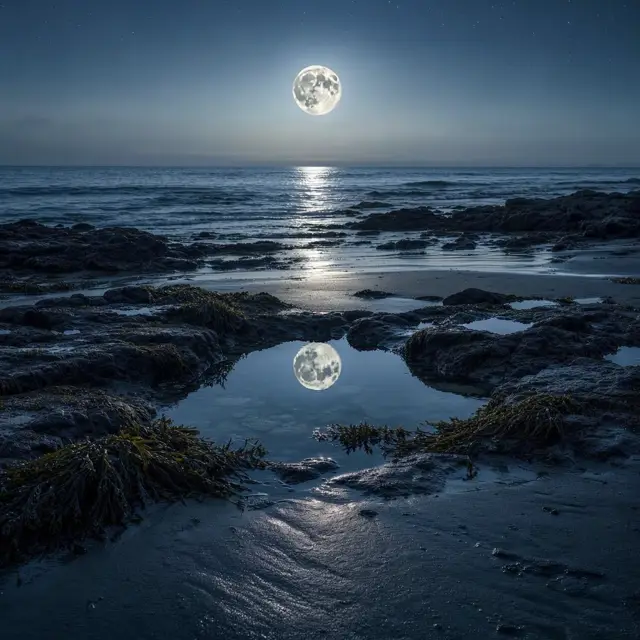
In most places, the ocean rises and falls about twice a day. The water drops to a low point called low tide, then climbs for several hours to high tide, then falls again. The moment when the tidal current stops before it turns around is called slack water.
The Moon is the main driver. Its gravity gets weaker with distance, so it pulls a little harder on the side of Earth facing it and a little softer on the far side. This stretches Earth slightly along the line to the Moon. Solid rock barely moves, but ocean water is fluid and can shift much more.
The Moon orbits in the same direction that Earth spins. So it takes about 24 hours and 50 minutes for the Moon to come back to the same spot in the sky. That is why, in many places, the strongest tidal pull repeats about every 12 hours and 25 minutes, and tides arrive a bit later each day.
Spring Tides Have Nothing to Do With Spring
About twice a month, around new moon and full moon, the Sun, Moon and Earth line up. The Sun's pull then adds to the Moon's, and the gap between high and low water is at its largest. This is called a spring tide. The name has nothing to do with the season. It comes from an old meaning of "jump" or "rise", as in a natural spring of water.
When the Moon is at first or third quarter, the Sun and Moon pull at right angles to each other. The Sun's force partly cancels the Moon's, and the range drops to its smallest. This is the neap tide. "Neap" is an Anglo-Saxon word meaning "without the power". Springs and neaps come about seven days apart.
In theory, the Moon alone would raise the open ocean by about 54 centimetres, and the Sun by about 25. Together at spring tide, they reach about 79 centimetres. Real coasts can see far more. In November 1998, Burntcoat Head in Canada's Bay of Fundy recorded a range of 16.3 metres.
From Moon Hunches to Tide Machines
People linked tides to the Moon long ago. Around 150 BC, Seleucus of Seleucia argued that the Moon caused them. In 725, Bede noted that tides come about 4/5 of an hour later each day, just as the Moon rises 4/5 of an hour later. The first tide table in China was recorded in 1056, mostly for visitors who wanted to see the famous tidal bore on the Qiantang River.
Not everyone agreed. In 1632, Galileo argued that tides came from Earth's spin and its trip around the Sun, and he rejected the Moon idea. Isaac Newton settled the matter in his Principia in 1687, using gravity to explain the pull of the Moon and Sun.
Predicting tides took clever tools. Starting in 1867, Lord Kelvin led the first systematic analysis of tide records. The result was a tide-predicting machine that used pulleys to add together six wave patterns. People "programmed" it by resetting gears and chains, and similar machines stayed in use until the 1960s.
Tides Rule Ships, Shores and Even Lakes
For sailors, tides are serious. Many rivers and harbours have a shallow bar at the entrance that blocks deep boats at low tide. Before automated navigation, working out tides was a key skill for naval officers. A Royal Navy exam certificate for lieutenants once said the officer was able to "shift his tides".
Between the high and low water lines lies the intertidal zone, which is covered and then uncovered every cycle. Life there has adapted to this harsh routine. Species form clear bands up the shore. How well a species copes with drying out sets its upper limit, while competition with other species sets its lower one.
Tides are not only a thing of the sea. Large lakes such as Superior and Erie get tides of just 1 to 4 centimetres, too small to notice among weather effects. Even the solid ground rises and falls, by up to about 55 centimetres at the Equator, which matters for GPS calibration. And a "tidal wave" is a misnomer: tsunamis have no link to the tide.