When Every Border Needed Its Own Deal
Before 1874, sending a letter abroad was a puzzle. Every pair of countries that swapped mail had to sign its own postal treaty. Without a treaty, letters had to be forwarded through a third country. In 1853, some southern German states sent their US-bound mail through France. Since the United States and France had no treaty, those letters then had to sail on a British or Belgian ship.
Deals could drag on for years. The United States drafted a treaty with France in 1852, but the two sides argued over how to split the inland postage. It was not signed until 1857, and then it was allowed to expire. When a new US Minister to France arrived in Paris in 1869, he found no postal deal at all between the two countries.
They finally swapped papers of ratification in July 1874. Just three months later, a new worldwide union made their treaty unnecessary.
One Price to Mail Anywhere
The United States had already pushed for change. In 1863, its Postmaster General called for an International Postal Congress. Delegates met in Paris and agreed on some general ideas, but they reached no deal.
Things moved once the German states united into the German Empire. The new German post set one set of rates at home, but that order stopped at the border. Postage from Berlin to New York still depended on which ship carried the letter across the Atlantic. So German Postmaster-General Heinrich von Stephan called a new congress in Bern, Switzerland, in 1874.
The delegates agreed to all of his proposals. The Treaty of Bern, signed on 9 October 1874, created the General Postal Union. It set a flat rate to mail a letter anywhere in the world, equal treatment for foreign and home mail, and let each country keep the money it collected. Best of all, a letter no longer needed stamps from every country it passed through.
Green Cards, Red Letters, Blue Mail
The treaty was signed by 21 countries, 19 of them in Europe. Membership grew fast, and at the second congress in 1878 the group took its current name, the Universal Postal Union.
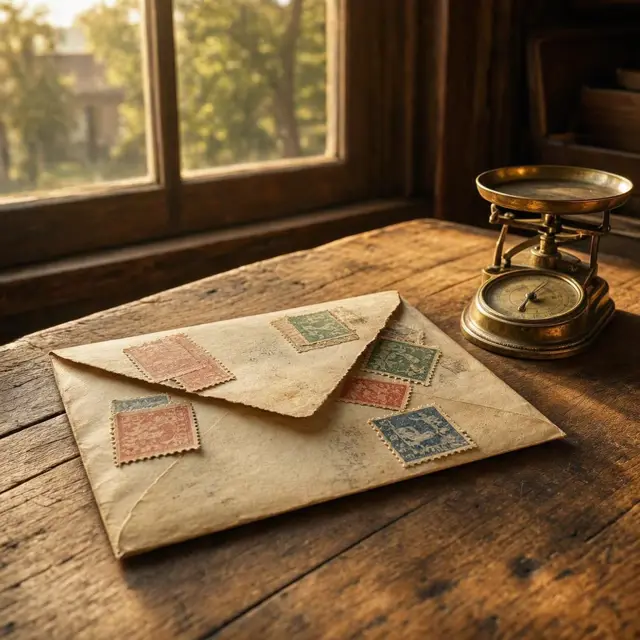
Toward the end of the 19th century, the union even set rules for how stamps should look. Values had to be shown in numerals, because values written out in words were not understood everywhere. Members also had to use matching colors: green for post cards, red for normal letters and blue for international mail. That system stayed in use for several decades.
French was the union's only official language until English was added as a working language in 1994. In 1948 the union became a specialized agency of the United Nations. Today it is the third oldest intergovernmental organization, after the Rhine Commission and the International Telecommunication Union. It is still based in Bern.
Who Pays to Deliver Your Letter?
The 1874 treaty let the sending country keep all the postage. The country at the other end delivered the letter for free. The thinking was simple: every letter would get a reply, so things would even out.
It did not always work. In 1906, Italy's post delivered 325,000 periodicals mailed in from other countries, while Italian publishers mailed none out. Some senders also used remailing, sending mail through another country so its post office paid for the rest of the trip. Remailing was banned in 1924.
In 1969 the union finally brought in terminal dues. The country sending more mail paid a fee to the one receiving more, based on the difference in weight. After five years of study failed to produce a cost-based plan, the fee was simply set at half a gold franc per kilogram. Later congresses kept raising it, tripling it in 1974 and tripling it again in 1979.
192 Members and a Stamp Registry
Any UN member state can join the union. A country outside the UN can join too, if two-thirds of the members agree. Today there are 192 members: 190 states plus two joint memberships for groups of territories. Aruba, Curacao and Sint Maarten share one seat, and so do all the British overseas territories.
Only four UN members stay outside: Andorra, the Marshall Islands, the Federated States of Micronesia and Palau. Their mail travels through other members instead, France and Spain for Andorra and the United States for the other three.
The members meet at a congress every four years, and delegates often receive special stamp albums made by member countries. With the World Association for the Development of Philately, the union launched a stamp numbering system in 2002, and over 25,000 stamps have been registered. Since 1969, the union has named the year's best postal services on 9 October, World Post Day.