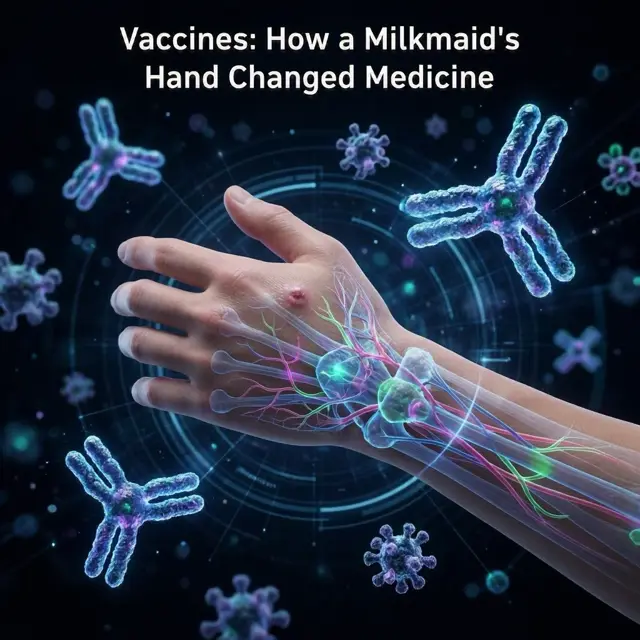
It started with cowpox, a country doctor, and an eight-year-old boy. The idea that followed wiped smallpox off the planet and now prevents a million measles deaths a year.
3 min read · 8 key facts · 10 terms decoded
Teaching the Body to Fight
A vaccine is a biological preparation that gives active acquired immunity against a disease. It usually contains weakened or killed microbes, toxins, or surface proteins that train the immune system to recognize and destroy a pathogen.
Vaccination is the most effective way to prevent infectious diseases. It led to the worldwide eradication of smallpox and dramatically reduced polio, measles, and tetanus.
An Old Idea Made Scientific
The roots run deep: Taoists in China practiced inoculation as far back as the 10th century, and Lady Mary Wortley Montagu brought the folk practice of smallpox inoculation from Turkey to Britain in 1721.
The breakthrough came in 1796, when Edward Jenner used cowpox pus from a milkmaid's hand to inoculate 8-year-old James Phipps, who then proved immune to smallpox.
Newer designs include the mRNA vaccine, which packages genetic instructions in lipid nanoparticles to make the body produce a protein the immune system learns to fight. An adjuvant is often added to strengthen the response.
The Payoff in Numbers
The impact is enormous. The measles vaccine alone is estimated to prevent a million deaths every year. In the United States, measles fell from 763,094 cases in 1958 to fewer than 150 a year after the vaccine arrived.
When enough people are vaccinated, herd immunity makes outbreaks hard to start. And a study of 657,461 children confirmed the MMR vaccine does not cause autism.
Key terms, decoded
active acquired immunity
Protection the body builds itself after exposure to a vaccine or infection.
adjuvant
A substance added to a vaccine to strengthen the immune response.
attenuated vaccine
A vaccine using live microbes weakened so they no longer cause disease.
Edward Jenner
The doctor who in 1796 used cowpox to create the first smallpox vaccination.
herd immunity
Protection that arises when enough people are immune that outbreaks struggle to spread.
inactivated vaccine
A vaccine made from microbes that have been killed.
mRNA vaccine
A vaccine using genetic instructions in lipid nanoparticles to make the body produce a target protein.
subunit vaccine
A vaccine using only a fragment of a microbe to trigger immunity.
toxoid vaccine
A vaccine made from an inactivated toxin rather than the microbe itself.
vaccine
A preparation that trains the immune system to fight a specific disease.
This Quicky is an original summary based on the Wikipedia article “Vaccine”, available under the CC BY-SA 4.0 license.