The Paper That Invented the Computer
In 1936, before any electronic computer existed, Alan Turing published "On Computable Numbers" — a paper that has been described as easily the most influential mathematics paper in history.
It introduced the Turing machine: an imaginary device reading and writing symbols on an infinite tape according to a table of rules. It was never meant to be built. Its purpose was to pin down, precisely, what the words algorithm and computation actually mean, which nobody had managed before.
The consequence is that the Turing machine can be regarded as a model of a general-purpose computer — the machine that can, given the right instructions, do anything any other computer can do. Turing is widely considered the father of theoretical computer science, and the strange part is the order of events. The theory of computing was worked out first, in the abstract, and the machines were built to match it afterwards.
Hut 8 and the Machine That Broke Enigma
During the Second World War Turing worked for the Government Code and Cypher School at Bletchley Park, Britain's codebreaking centre and the source of Ultra intelligence. He led Hut 8, the section responsible for German naval cryptanalysis.
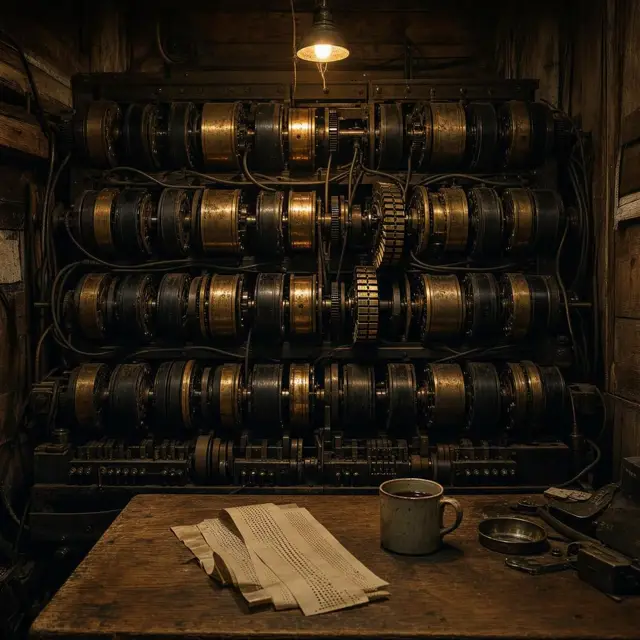
His central contribution was the bombe, an electromechanical machine that searched for the daily settings of the Enigma machine. He specified it by improving on the pre-war Polish bomba method. It worked, and it scaled: more than two hundred bombes were in operation by the end of the war. He also devised Banburismus, a statistical technique using a unit he named the ban to cut down the amount of testing required.
The payoff was enormous. Turing's work was crucial in cracking intercepted messages that let the Allies win the Battle of the Atlantic, and the historian Harry Hinsley estimated that the Bletchley effort shortened the war in Europe by more than two years.
Can Machines Think?
After the war Turing worked at the National Physical Laboratory, designing the Automatic Computing Engine, one of the earliest designs for a stored-program computer. In 1948 he joined Max Newman's Computing Machine Laboratory at the University of Manchester and helped develop the early Manchester machines.
Then in 1950 he published "Computing Machinery and Intelligence", which sidestepped the unanswerable question "can machines think?" and replaced it with something testable: could a machine hold a conversation indistinguishable from a human's? That proposal became the Turing test, and it is still argued about today.
He was not finished. In 1952 he published "The Chemical Basis of Morphogenesis", asking how chemical reactions spreading through tissue can generate biological patterns — stripes, spots, structure. He predicted oscillating chemical reactions of the kind first actually observed in the 1960s. He did this before the structure of DNA was understood.
Prosecuted, Then Pardoned Sixty Years Late
In 1952, Turing was prosecuted for homosexual acts, then a criminal offence in Britain. Offered prison or hormone treatment — a procedure commonly called chemical castration — he accepted the treatment.
He died on 7 June 1954, aged 41, from cyanide poisoning. An inquest recorded suicide, though the evidence is also consistent with accidental poisoning.
He had never been properly recognised in his lifetime, because much of his most important work was covered by the Official Secrets Act. The country he helped save could not be told what he had done. Recognition came only long after his death: a campaign in 2009 led Prime Minister Gordon Brown to issue an official public apology for "the appalling way [Turing] was treated"; Queen Elizabeth II granted a pardon in 2013; and the informally named "Alan Turing law" of 2017 retroactively pardoned men cautioned or convicted under the historical legislation that criminalised homosexual acts.
The Marathon Runner on the Fifty-Pound Note
Turing was a serious distance runner, which tends to surprise people. His marathon trial time was only 11 minutes slower than the Olympic race time of 2 hours 35 minutes set by British silver medallist Thomas Richards. He was, in other words, within touching distance of Olympic standard as a side pursuit.
His legacy in mathematics and computing is now widely recognised, with statues, buildings, and an annual award for computing innovation carrying his name. His portrait appears on the Bank of England £50 note, first released on 23 June 2021 — his birthday. In a 2019 BBC series, the audience vote named him the greatest scientist of the 20th century.
The cognitive scientist Douglas Hofstadter summarised the debt bluntly, calling Turing largely responsible not only for the concept of computers and clear theorems about their powers, but also for the cracking of German ciphers — and concluding that it is fair to say we owe much to Turing for the fact that we are not under Nazi rule today.