The Notary's Son From Vinci
History's most celebrated genius was born on the margins of respectable society. Leonardo arrived on 15 April 1452, in or near the Tuscan town of Vinci, the son of a successful notary named Piero and a lower-class woman named Caterina, born out of wedlock.
Around the age of 14, he entered the Florence workshop of the painter and sculptor Andrea del Verrocchio. It was less an art class than a full education: drawing, painting, sculpture, chemistry, metallurgy, and mechanics, all under one roof.
The talent around him was absurd. Future masters like Botticelli and Perugino trained in the same circle. Leonardo qualified as a master in 1472, ready to begin a career that would make him the very symbol of the Renaissance.
Milan, a Giant Horse, and an Unfinished Habit
Leonardo's most productive years came in Milan, where he served Duke Ludovico Sforza from 1482 to 1499. There he painted the Virgin of the Rocks and The Last Supper, which became the most reproduced religious painting of all time. Around 1485 he drew the Vitruvian Man, now a cultural icon in its own right.
Milan also showcased his grandest failure: the Gran Cavallo, a colossal bronze equestrian monument that was never cast.
After Sforza was overthrown, Leonardo drew strategic maps for Cesare Borgia, then returned to Florence, where in October 1503 he began a portrait of Lisa del Giocondo. He carried the Mona Lisa with him for over a decade, never quite finishing it. That was the pattern of his life: fewer than 25 major works are attributed to him, and many remain unfinished.
Thirteen Thousand Pages the World Never Read
Leonardo's true masterpiece may be his notebooks: roughly 13,000 surviving pages of drawings and notes on anatomy, astronomy, botany, cartography, painting, and more. He performed dissections of human cadavers and produced anatomical drawings of unprecedented accuracy.
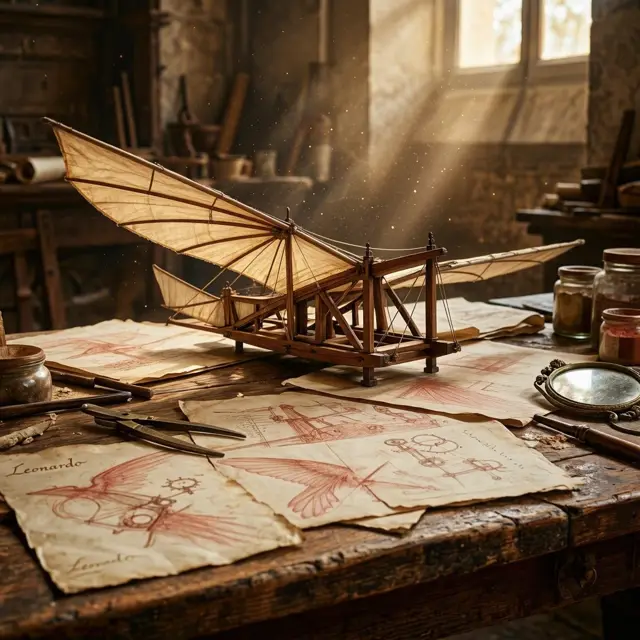
His imagination ran centuries ahead of his tools. The pages contain designs for flying machines, an armored fighting vehicle, concentrated solar power, and a double-hulled ship. Most were never built and many were not even feasible with Renaissance technology, though smaller inventions, like an automated bobbin winder and a machine for testing the strength of wire, quietly entered the world of manufacturing.
Then comes the tragedy: he never published any of it. His discoveries in anatomy, optics, geology, and engineering had little to no direct influence on the science that came after him. The world had to rediscover what Leonardo already knew.
A Mechanical Lion for a King
In 1516, King Francis I invited the aging master to France and gave him the manor house of Clos Lucé near Amboise. Leonardo spent his final three years there, designing an ambitious castle town at Romorantin and delighting the court with a mechanical lion that walked and then opened its chest to reveal a cluster of lilies.
His body was failing before his mind did. A 1517 portrait shows his right arm wrapped in clothing, suggesting partial paralysis, which likely explains why late works stayed unfinished. He died on 2 May 1519, aged 67.
His legend has only grown since. The Mona Lisa is regarded as the world's most famous painting, and in 2017 the painting Salvator Mundi, attributed in whole or part to Leonardo, sold at auction for 450.3 million dollars, the highest price ever paid for a painting at public auction.