He Faked Insanity to Dodge a Death Sentence
Around 1010, the Fatimid Caliph al-Hakim summoned a brilliant engineer from Basra to Egypt with an ambitious task: tame the Nile's yearly floods by building a dam near what is now Aswan. Ibn al-Haytham studied the river firsthand, surveying its course from end to end, and quickly realized the project was far beyond what the era's tools and knowledge could achieve.
Failing a caliph's order could mean execution, so Ibn al-Haytham reportedly pretended to have lost his mind. The ruse worked, in a grim way, he was placed under house arrest instead of facing worse punishment, and remained confined until al-Hakim's death in 1021.
A Decade Under House Arrest Became Science's Turning Point
Stuck indoors for roughly a decade, Ibn al-Haytham turned his forced isolation into the most productive stretch of his life. During this confinement he wrote his masterpiece, the seven-volume Kitab al-Manazir, known in the West as the Book of Optics, composed between 1011 and 1021.
The book didn't just describe how light behaves, it modeled how experiments themselves should work. Ibn al-Haytham insisted every claim about nature be tested through observation, not simply argued about in theory. That approach helped shape what we now call the scientific method, roughly five centuries before the European Renaissance popularized it.
He Solved a Debate That Had Confused Thinkers for Centuries
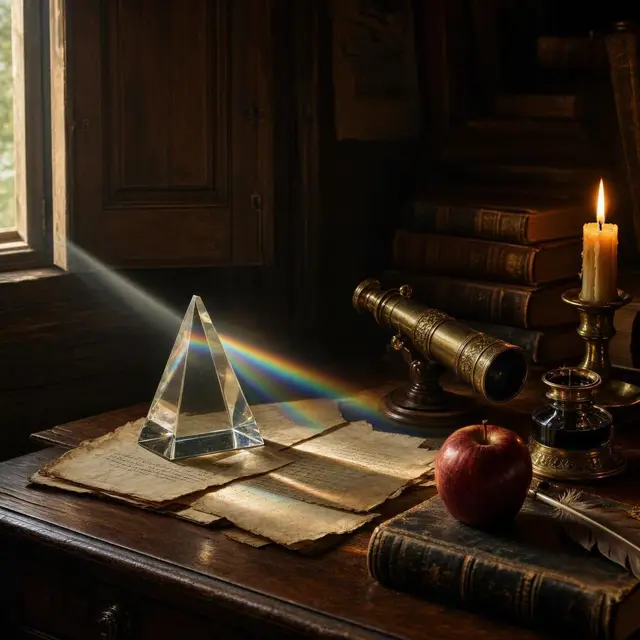
Ancient scholars had long argued about how seeing actually works. Some, following the mathematician Euclid, believed the eye shot out invisible rays that reached out and touched objects. Ibn al-Haytham flipped that idea entirely. He proved that light bounces off an object first, then travels into the eye, a theory known as intromission.
He went further, arguing that vision isn't just a mechanical process happening in the eyeball. It happens in the brain, shaped by memory and past experience, which is why two people can look at the same scene and notice completely different details. This insight anticipated modern ideas about perception long before neuroscience existed as a field.
He Watched a Solar Eclipse Through a Pinhole, on Purpose
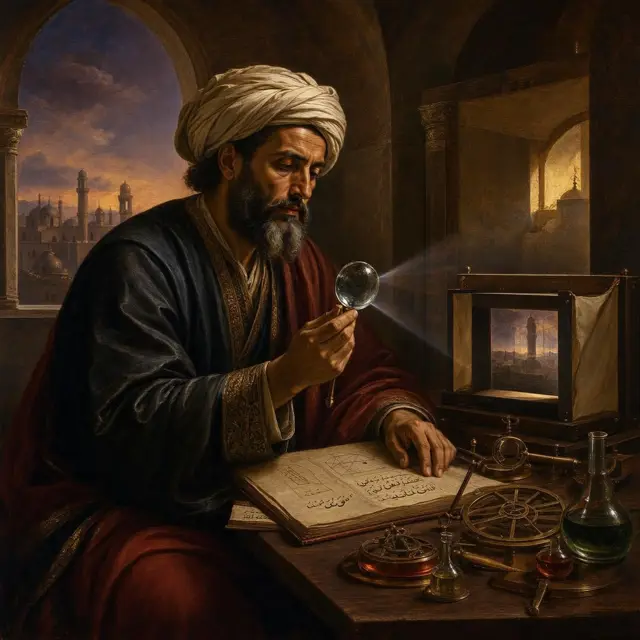
Long before photography existed, Ibn al-Haytham gave the first clear scientific description of the camera obscura, a darkened box or room with a tiny hole in one wall that projects an upside-down image of whatever sits outside.
He used this device to observe a partial solar eclipse safely, noting that sunlight passing through the small opening formed a crescent shape matching the eclipse itself. This simple, careful setup let him study light without ever risking damage to his eyes, and it planted an idea that would eventually lead to the modern camera centuries later. Photographers still use the same basic pinhole principle today, whether in classroom science experiments or in genuine pinhole cameras built without any lens at all.
More Than 200 Books, but Only a Quarter Survived
Ibn al-Haytham was far more than an optics specialist. Across his lifetime he wrote roughly 200 works covering astronomy, mathematics, engineering, philosophy, and even medicine, yet only about 55 of these texts are known to have survived to the present day.
Among his surviving works is Doubts Concerning Ptolemy, written between 1025 and 1028, in which he openly challenged contradictions inside the ancient astronomer Ptolemy's model of the universe. He also tackled advanced mathematics, including a geometry puzzle that mathematicians still call Alhazen's problem in his honor today. That puzzle, involving light reflecting off a curved mirror, resisted a full general solution for centuries after he first posed it.
A Thousand Years Later, He's Still Everywhere
Ibn al-Haytham's fingerprints are still all over modern science and culture, a thousand years on. A crater on the Moon and an asteroid both carry the name Alhazen, and his portrait even appears on Iraq's 10,000 dinar banknote.
In 2015, UNESCO declared the International Year of Light partly to mark 1,000 years since his groundbreaking work on optics. He even reached modern television audiences: the documentary series Cosmos: A Spacetime Odyssey dramatized his story, with actor Alfred Molina providing his voice.
Historians of science increasingly credit him as one of the earliest people to insist that ideas about the natural world must be tested, not just argued, a habit of mind that eventually became the backbone of how science itself gets done.