The Boy Who Fit in a Quart Mug
Isaac Newton arrived early and barely alive. Born prematurely on Christmas Day 1642 by the Old Style calendar, at Woolsthorpe Manor in Lincolnshire, he was so small that his mother said he could have fit inside a quart mug. His father had died three months before his birth, and when Isaac was three his mother remarried and left him with his grandmother, a separation that bred lasting resentment.
School revealed his engine: spite. At The King's School in Grantham, revenge against a schoolyard bully drove him to become the top student, and he spent his spare time building sundials and models of windmills.
In June 1661 he entered Trinity College, Cambridge, as a subsizar, paying his way through service work until he earned a scholarship in 1664. Nothing about the arrangement suggested the world was about to change.
Two Golden Years of Plague
In 1665 the Great Plague closed Cambridge, and Newton went home to Woolsthorpe. What followed may be the most productive stretch in the history of thought. In roughly two years, he developed his theories of calculus, optics, and gravitation, the period sometimes called his annus mirabilis, his year of wonders.
The pace was staggering. By May 1665 his calculus could already compute tangent lines and curvature, and in 1664-65 he discovered the generalized binomial theorem, called one of the most powerful results in the whole of mathematics. One observer later judged that no other achievement in the history of science compares with what Newton did in those two golden years.
He was rewarded with astonishing speed: at just 26, in 1669, he was appointed Lucasian Professor of Mathematics at Cambridge. He was, however, a famously poor lecturer; his classes were almost always empty, and only three students were assigned to him in his entire career.
The Book That Unified the Heavens
In 1687 Newton published the Principia, and physics has never been the same. The book formulated the laws of motion and universal gravitation, achieving the first great unification in physics and establishing classical mechanics. With one mathematical framework he derived Kepler's laws of planetary motion, explained the tides, traced the paths of comets, and showed that objects on Earth and bodies in the heavens obey the same rules.
His viewpoint dominated science for centuries until relativity superseded it, and even now his laws remain accurate enough for everything moving far below the speed of light.
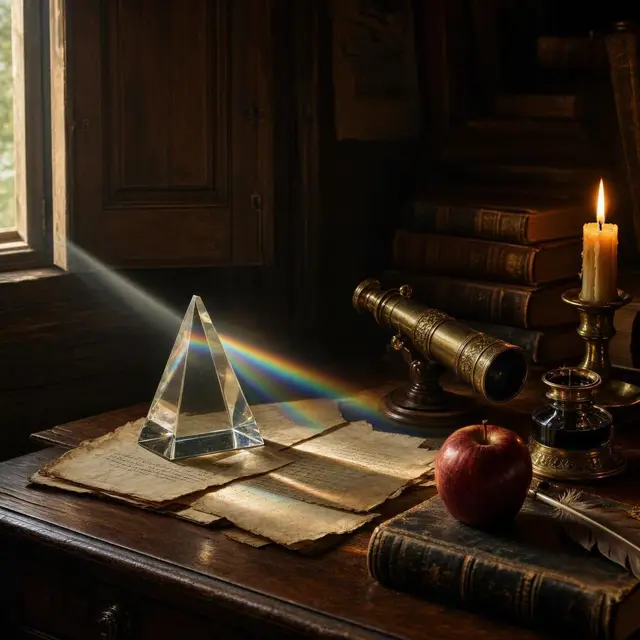
Light itself was his other kingdom. From his observation that a prism splits white light into the colours of the spectrum, he built a sophisticated theory of colour, published in his 1704 book Opticks. Along the way, in 1668, he constructed the first functional reflecting telescope, using mirrors instead of lenses.
The Mint, the Feuds, and the Secret Notebooks
Newton guarded his glory ferociously. His priority dispute with Gottfried Wilhelm Leibniz over the invention of calculus turned poisonous, and when the Royal Society proclaimed Newton the true discoverer in 1711, it was Newton himself who wrote the report's concluding remarks branding Leibniz a fraud.
His second career was stranger than his first. As Warden and then Master of the Royal Mint from 1696 until his death, he improved the accuracy and security of British coinage and personally pursued counterfeiters. He served twice as a Member of Parliament, was knighted by Queen Anne in 1705, and presided over the Royal Society from 1703 to 1727.
Privately, he was a devout but unorthodox Christian who kept his views to himself, and he poured years into alchemy and biblical chronology, work that stayed unpublished until long after his death. He never married. He died on 31 March 1727, aged 84, and was buried in Westminster Abbey.