Two Careers, One Life, No Overlap
Hedy Lamarr was born Hedwig Eva Maria Kiesler on 9 November 1914 in Vienna, daughter of a banker and a pianist from Budapest. The world knew her as a film star. That was roughly half the story.
She was an Austrian and American actress and inventor, and during the Second World War she co-invented a radio guidance system for Allied torpedoes. These were not two versions of the same fame. Her screen career was public, promoted and enormously profitable; her inventing was private, unpaid and almost entirely ignored while she lived.
The two never blended. Studio publicity had no interest in a leading lady who spent her evenings on engineering problems, and the military establishment had no interest in weapons guidance proposed by a movie actress. She spent decades being extremely famous for the wrong half of her ability.
Escaping the Arms Dealer
In 1933 she starred in *Ecstasy*, a film that became both celebrated and notorious for its nude scenes. That same year, aged 18, she married Friedrich Mandl, an Austrian arms dealer.
The marriage was controlling and she left it in 1937, fleeing under circumstances that accounts still disagree about — either disguised as her own maid, or slipping away after a dinner party. She reached Paris, then London, where she met Louis B. Mayer and secured an MGM contract at $500 a week.
Hollywood worked quickly. She made her American debut in *Algiers* in 1938 opposite Charles Boyer and became a star. *Boom Town* in 1940 earned $5 million. Her greatest success came with the religious epic *Samson and Delilah* in 1949, the highest-grossing film of 1950. She received a star on the Hollywood Walk of Fame in 1960, and her final film was released in 1958.
A Player Piano Aimed at a Torpedo
The invention grew out of a problem she had overheard, not one she had been assigned. In the late 1930s, sitting through Mandl's business meetings, she learned about the difficulties of guiding torpedoes by radio.
The weakness was obvious once stated: a radio-guided torpedo follows a single frequency, and an enemy who finds that frequency can jam it. Lamarr's answer, developed with composer George Antheil, was to stop staying on one frequency at all. Their frequency-hopping system would make transmitter and receiver leap together through many frequencies in a pattern known only to both ends, so a jammer would never find the signal sitting still.
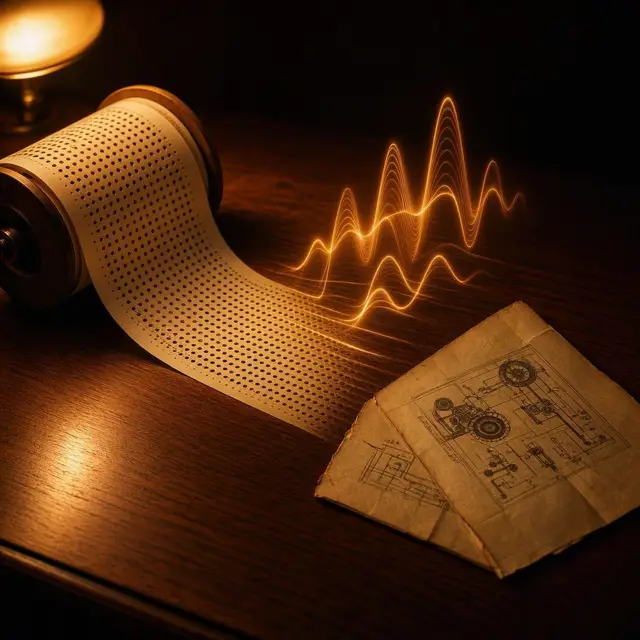
Antheil's contribution was the synchronisation, and its inspiration was gloriously unlikely: the perforated player-piano rolls he had used to coordinate multiple instruments in his *Ballet Mécanique* of 1923-24. The mechanism that once synchronised avant-garde music was repurposed to synchronise a weapon.
Right Fifty Years Too Early
Lamarr submitted the concept to the National Inventors Council in December 1940. US Patent 2,292,387 was granted on 11 August 1942, filed under her married name, Hedy Kiesler Markey — a detail that helped bury her authorship for decades.
The Navy rejected it as impractical. No operational system used the approach until 1962, three years after the patent had expired. Neither inventor earned anything from it.
The idea, however, turned out to be foundational. Spread spectrum techniques, of which frequency hopping is a cornerstone, now protect wireless data from interception and interference — used in Bluetooth, early versions of Wi-Fi, and GPS. Recognition arrived very late: the Electronic Frontier Foundation Pioneer Award in 1997, shared with Antheil, and induction into the National Inventors Hall of Fame in 2014, fourteen years after her death on 19 January 2000, aged 85.