Walls Raised in a Single Year
In 1238, Muhammad I Ibn al-Ahmar, the first Nasrid ruler of Granada, climbed a hill called Sabika and marked out the foundations of a castle. According to an old Arabic manuscript, the outer walls were finished before the year was over, and water was already flowing in through a new channel from the river.
That was the start of the Alhambra, a palace and fortress complex in Granada, Spain. It is one of the most famous monuments of Islamic architecture and the only well-preserved palace from the medieval Islamic world. The Nasrids ruled the Emirate of Granada, the last Muslim state of al-Andalus, and every ruler after Ibn al-Ahmar kept changing the site.
The name comes from the Arabic for the red one, short for the red fortress. The color comes from its walls, built of rammed earth made with local clay full of iron oxide. The biggest building campaigns came in the 14th century, under Yusuf I and Muhammad V, and they gave the royal palaces much of their famous look.
A Whole City Above the City
In Nasrid times, the Alhambra was a separate, self-contained town above the rest of Granada. It had a main mosque, public baths, roads, houses, workshops, a tannery, and at least six major palaces. At its western tip stands the Alcazaba, a citadel whose tallest tower rises 26 metres.
The whole site runs about 740 metres long and up to 205 metres wide on a narrow ridge. Water was the key. Before the Nasrids, the hilltop relied on rainwater and whatever could be carried up from the river. A long canal changed that. Much of it still exists today, drawing water from the Darro River about 6.1 kilometres east and feeding pools, fountains, and channels all through the palaces.
The palaces were built with the weather in mind. Courtyards usually ran north to south, so the main halls caught direct midday sun in winter, while deep porches blocked the high summer sun. Many buildings had a mirador, a room jutting out for views of gardens or the city. Some of their windows sit low because people sat on the floor.
Ceilings Made of Thousands of Pieces
The Nasrid palaces were built to be admired from the inside. Tile mosaics covered the lower walls, and carved stucco covered the upper walls with patterns of leaves, geometry, and Arabic writing. Today much of it looks pale, but it was originally painted in bright red, blue, and gold.
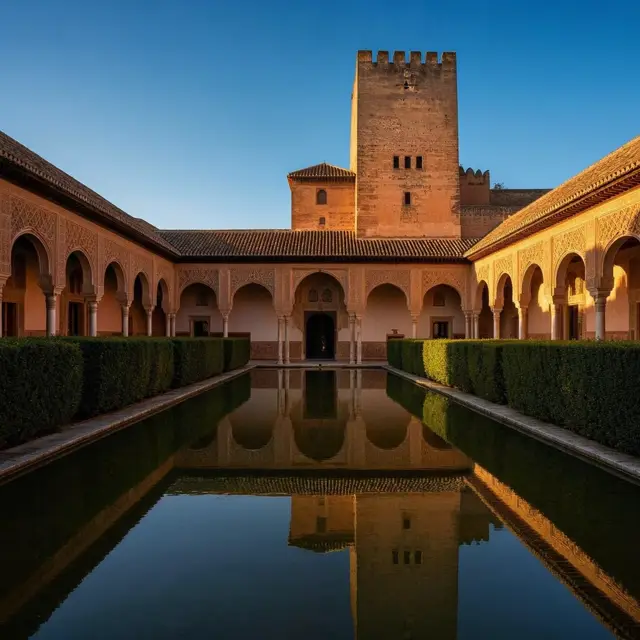
In the Comares Palace, the Court of the Myrtles centres on a reflecting pool 34 metres long, lined with myrtle hedges. Behind it rises the Hall of the Ambassadors, the largest room in the Alhambra, a square hall 11.3 metres wide and 18.2 metres high. Its domed wooden ceiling is made of 8,017 interlinked pieces.
The Palace of the Lions, built under Muhammad V, has a courtyard with a fountain ringed by twelve marble lions. A poem by Ibn Zamrak carved around the basin praises the fountain and even explains how its water system worked. Nearby, the Hall of Two Sisters is topped by a dome of muqarnas, built from at least 5,000 prism-shaped pieces.
Walls That Speak in Poetry
Arabic inscriptions run all over the Alhambra, carved into stucco, wood, and marble and glazed onto tiles. Many of them are poems. Some poems in the Palace of the Lions are written in the first person, as if the room itself were talking to the reader.
Little is known about the builders, but a lot is known about the poets. Ibn al-Jayyab, Ibn al-Khatib, and Ibn Zamrak each led the royal writing office, and some also served as the sultan's chief minister. Their time in office lines up with the big building phases, which suggests they helped lead the work. They also wrote much of the poetry on the walls.
The tiles hide mathematics too. They contain nearly all, if not all, of the 17 possible wallpaper groups, a unique feat in world architecture. The artist M. C. Escher visited in 1922, and his study of the tile patterns inspired his later work on shapes that fit together to cover a flat surface.
Saved From Dynamite
In January 1492, the last Nasrid sultan, Muhammad XI, surrendered Granada without the Alhambra itself being attacked. Ferdinand and Isabella moved in. In the Hall of the Ambassadors, Christopher Columbus presented his plan to cross the Atlantic, and on 17 April 1492 the monarchs signed the contract for his voyage.
In 1527, work began on a huge Renaissance palace for Charles V right in the middle of the complex, after part of the Comares Palace was knocked down to make room. It was abandoned in 1637 without a roof and only completed after 1923. Over the following centuries the Alhambra fell into neglect, with local governors and their families living inside the decaying palaces.
The worst moment came in 1812. French troops leaving Granada tried to blow up the whole complex. They destroyed eight towers before a Spanish soldier, José Garcia, disabled the remaining fuses, saving what stands today. In 1832, Washington Irving's Tales of the Alhambra drew worldwide attention, and in 1984 the site became a UNESCO World Heritage Site.