A Masterpiece at Seventy
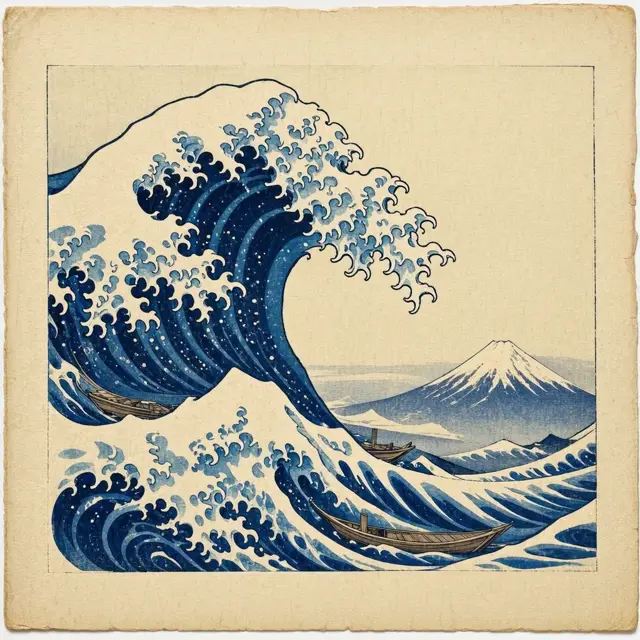
In late 1831, the Japanese ukiyo-e master Katsushika Hokusai — then in his seventies — published the first print of a new series, *Thirty-six Views of Mount Fuji*. It showed a monstrous wave curling like a claw over three fishing boats, with tiny, snow-capped Fuji sitting calmly in the distance. The series proved so popular it grew to 46 prints, but none ever escaped the shadow of the first.
Hokusai believed mastery only arrived with age. By ninety he expected to "progress further", and by one hundred to "reach the level of the marvellous and divine". The Great Wave, made when most artists retire, was his proof of concept.
Thirty Men and a Ten-Meter Wall of Water
Look closely and the drama sharpens. The three vessels are *oshiokuri-bune* — fast barges that rushed live fish to market — each 12 to 15 meters long with about eight rowers; roughly 30 men cling to them in the scene. Against them rises a wave estimated at 10 to 12 meters, its foam splitting into claw-like fingers.
The composition is a East-West fusion: traditional Japanese printmaking joined to the graphical perspective techniques Europe had developed. And its most famous color was an import too. The deep, fade-resistant Prussian blue pigment had recently arrived from Holland, and Hokusai's series was among the first in Japan to use it — the publisher advertised the novelty proudly. The wave's blue never faded; older indigo prints did.
One Design, Eight Thousand Copies
The Great Wave was never a single object. Hokusai drew the design; carvers cut a wooden block for each color; printers pressed them by hand onto paper, achieving gradations — a technique called *bokashi* — no machine could match. About 1,000 copies came off the first blocks, and perhaps 8,000 impressions were made in all.
Time has thinned them brutally. As of 2022, only about 113 first-edition impressions are known to survive worldwide, many faded, because Edo-period pigments were light-sensitive. Scarcity did the rest: in 2023 a copy sold at Christie's for $2.8 million, a price matched again at Sotheby's Hong Kong in 2025. Not bad for a mass-produced image ordinary Japanese townspeople once bought cheaply.
The Wave That Flooded the West
When Japan opened to Western trade after 1868, its prints poured into Europe and detonated a craze the French called Japonisme. The Great Wave hit hardest of all. Claude Debussy kept a copy in his studio while composing his orchestral sea masterpiece *La Mer* — and had the print placed on the score's cover. Vincent van Gogh praised its draftsmanship and called its emotional impact "terrifying". Monet drew on its perspective; sculptor Camille Claudel answered it with three dancing women in place of the boats.
The flood never receded. Today the wave crashes across Apple's water-wave emoji, Japan's redesigned 1,000-yen banknote issued in 2024, bronze sculpture in England, and countless parodies — earning its description as possibly "the most reproduced image in the history of all art".