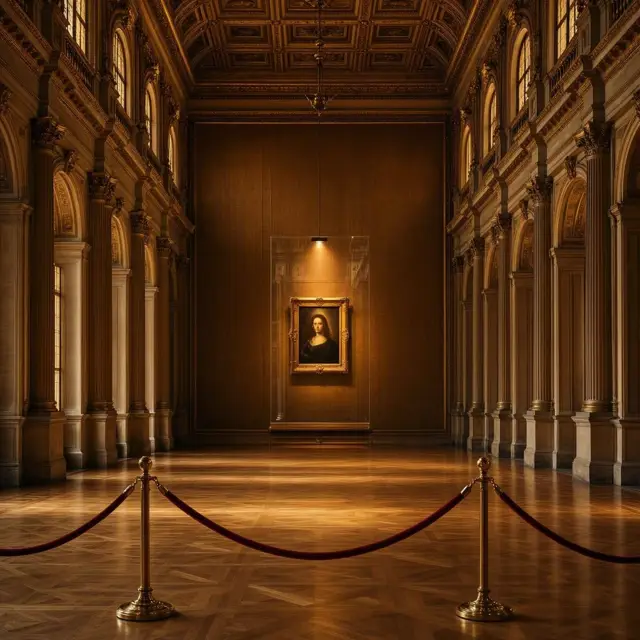
A Portrait Leonardo Never Delivered
Around 1503, Florentine silk merchant Francesco del Giocondo commissioned a portrait of his wife, Lisa del Giocondo, likely to celebrate a new home and the birth of a son. Leonardo da Vinci took the job — and then never handed the painting over. He kept refining it, possibly as late as 1517, by which point his right hand had become partly paralyzed, perhaps explaining why he left it unfinished.
The painting itself is surprisingly small: oil on a poplar wood panel, just 77 by 53 centimeters. After Leonardo's death in 1519, King Francis I of France acquired it, and it has hung in the Louvre since 1797 — property of the French Republic, and by law impossible to sell.
The Trick Inside the Smile
The Mona Lisa's expression owes its magic to sfumato — Leonardo's technique of blending tones so softly that edges dissolve like smoke. He concentrated the ambiguity in exactly two places: the corners of the mouth and the corners of the eyes.
Science has caught the smile in the act. Harvard researcher Margaret Livingstone showed that the smile is visible mainly to your peripheral vision — look directly at the mouth and it fades; glance at her eyes and the smile blooms back. Add the famous "Mona Lisa illusion", where her gaze seems to follow you around the room, and you have a portrait that behaves less like a picture and more like a presence. Ultra-high-resolution scans even suggest she once had eyebrows and eyelashes, gradually lost — possibly to overzealous cleaning.
The Theft That Made Her Immortal
On August 21, 1911, Vincenzo Peruggia — a Louvre worker who had helped build the painting's protective glass case — hid inside the museum on its closed day and simply walked out with the Mona Lisa. The next morning, painter Louis Béroud found a blank space on the wall.
The investigation became a circus. Police arrested the poet Guillaume Apollinaire, who implicated his friend Pablo Picasso; both were questioned and cleared. The real thief kept the painting in his Paris apartment for two years. An Italian patriot, Peruggia believed the masterpiece belonged in Italy — and in December 1913 he tried to sell it to the director of Florence's Uffizi Gallery. The painting was exhibited there for two weeks before returning to Paris in January 1914. Peruggia served six months; the Mona Lisa's newspaper fame became a global legend, later fueled by operas, films, and Nat King Cole's hit song.
Thirty Seconds With the Queen
Today the Mona Lisa lives behind bulletproof glass in a climate-controlled enclosure — humidity pinned near 50%, temperature between 18 and 21°C, lit by a custom LED lamp that strips out harmful radiation. She has survived a thrown rock, red spray paint, a ceramic teacup, a smeared cake, and thrown soup; since the glass went up, none of it has touched her.
The crowds are the real spectacle. Around 10.2 million people a year come to see her, funneled through a queuing system that grants each group roughly 30 seconds of viewing time. Her paper value matches the devotion: insured for $100 million before her 1962 American tour — about $1 billion in today's money, still the Guinness World Record for the highest painting insurance valuation in history.