Market Day, April 26, 1937
On a Monday market day during the Spanish Civil War, Nazi Germany's Condor Legion — flying in support of Francisco Franco's forces alongside fascist Italy — subjected the Basque town of Guernica to a devastating aerial assault, raining roughly 3,000 incendiary bombs on it for about two hours. Most of those in town were women and children; the men were away at the front. The nearest military factory went untouched. This was terror bombing of civilians, and the world soon knew it.
In Paris, Pablo Picasso had been struggling with an uninspired commission for the Spanish pavilion at the upcoming International Exposition. Then he read journalist George Steer's eyewitness account of Guernica, published in *The Times* and *The New York Times*. He abandoned his sketches and started over.
Thirty-Five Days of Fury
Picasso began new sketches on May 1, 1937, and finished the enormous canvas — 3.49 by 7.76 meters — on June 4: thirty-five working days. He painted it in matte house paint, specially formulated at his request, in a Paris studio found for him by photographer and anti-fascist activist Dora Maar.
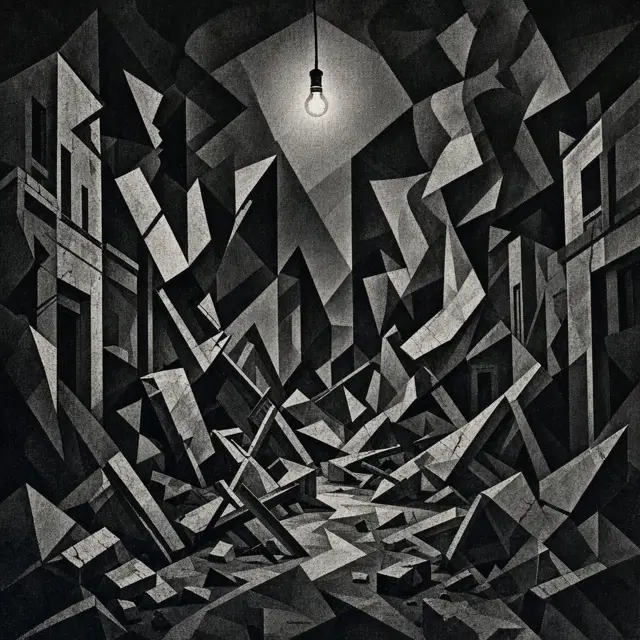
Maar did far more than find the room. She photographed the painting's evolution day by day, pushed Picasso toward bolder political creation, and even painted portions of the dying horse herself. Her black-and-white photography shaped the painting's most radical choice: no color at all. Grey, black, and white — the palette of a newspaper photograph, for a crime the world had just read about in the newspapers.
A Nightmare You Can Walk Through
Guernica offers no heroes and no rescue — only a lightbulb glaring like an all-seeing eye over a collapsing world:
- A mother screams, holding her dead child, beneath a wide-eyed bull.
- A horse gapes with a spear wound; hidden in its nostrils and teeth, a skull.
- A dismembered soldier's severed hand still grips a broken sword — from which a single flower grows.
- Women burn, flee, and scream, one with a dagger where her tongue should be.
Critics at the 1937 Paris Exposition were divided — some Spanish officials wanted it replaced with something more traditional, and one famous critic dismissed it as "jerky". History overruled them. A widely told story from occupied Paris has a German officer pointing at a photo of the mural and asking Picasso, "Did you do that?" — to which the painter replied: "No, you did."
The Exile That Outlived a Dictator
After touring Europe to raise funds for Spanish war relief — arriving in London the very day the Munich Agreement was signed — Guernica crossed the Atlantic and settled at New York's Museum of Modern Art. There it stayed for 42 years, under Picasso's explicit condition: the painting would not set foot in Spain until "liberty and democracy" returned.
Franco died in 1975; Spain's democratic constitution followed in 1978; and in September 1981 Guernica finally came home, displayed at first behind bomb- and bullet-proof glass. Nearly a million visitors saw it within a year. It now hangs in Madrid's Museo Reina Sofía, considered too fragile to travel. A full-size tapestry copy hangs at the United Nations outside the Security Council chamber — where, in February 2003, officials covered it with a blue curtain while the case was being made on television for war in Iraq. Even veiled, the painting made its point.