The View From Room Upstairs
In May 1889, after a mental breakdown and the infamous crisis in which he mutilated his own left ear, Vincent van Gogh voluntarily committed himself to the Saint-Paul-de-Mausole asylum, a former monastery near Saint-Rémy-de-Provence. The facility was half empty, which gave him a rare luxury: a second-story bedroom and a ground-floor studio.
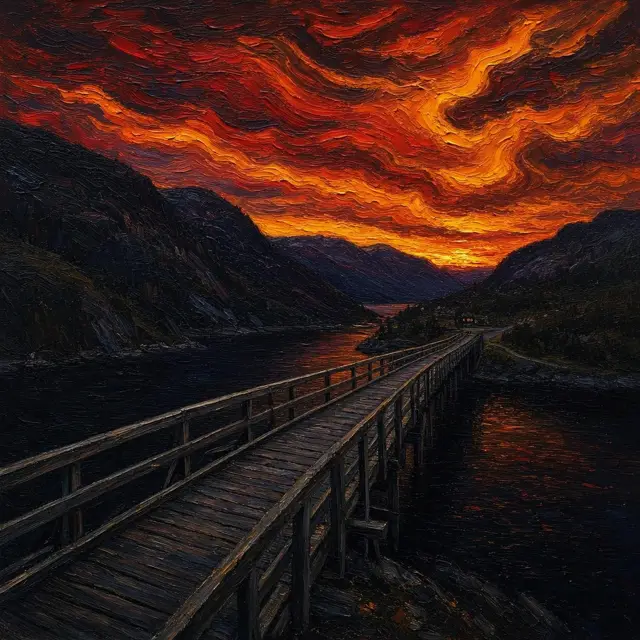
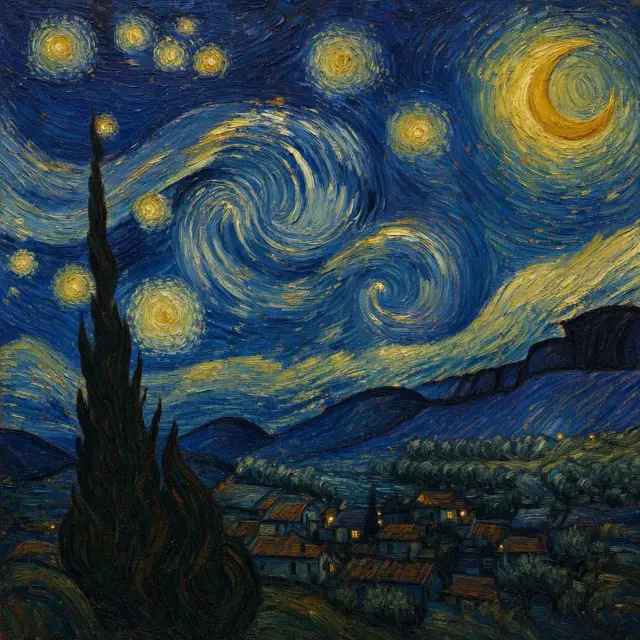
He stayed a year and painted relentlessly. Around June 18, 1889, he captured the view through his east-facing, iron-barred window just before sunrise — and then improved on reality. The brilliant "star" is the planet Venus, which astronomers confirm really did blaze over Provence that spring. But the tidy village below never existed; he added it from sketches, along with towering cypresses and that impossible, churning sky.
"A Failure" — Signed, the Artist
Here is the painting's cruelest irony: Van Gogh didn't rate it. In a November 1889 letter to painter Émile Bernard he called The Starry Night a "failure", confessing he had let himself be "led astray into abstraction". When he listed paintings worth sending to his brother Theo that September, he left it out — "the rest says nothing to me," he wrote.
The swirls he distrusted became the most loved brushstrokes in modern art. Interpreters have found everything in them: religious visions, echoes of newly photographed spiral galaxies, even the "fireworks of electrical impulses" of his illness. His own letters are more modest — the cypresses simply occupied his thoughts, as forms, not symbols.
The Long Road to New York
Van Gogh finally mailed the canvas to Theo in September 1889. Within two years both brothers were dead — Vincent in July 1890, Theo six months later — and the painting began a quiet odyssey through European hands: Theo's widow Jo, a French poet, a dealer who sold it back to Jo, then three decades with a Rotterdam collector.
In 1938 the dealer Paul Rosenberg acquired it, and in 1941 — after fleeing Nazi-occupied France — he passed it to New York's Museum of Modern Art, which traded two Cézannes and a Toulouse-Lautrec to get it. It has anchored MoMA's collection ever since and rarely leaves the building. Pigment analysis later confirmed the recipe of that sky: ultramarine and cobalt blue, with indian yellow and zinc yellow burning in the stars and moon.
Why the Swirls Won
The Starry Night is now called a "touchstone of modern art" and stands among the most recognizable paintings in the Western canon — reproduced on dorm-room posters, coffee mugs, and phone cases in numbers no one can count. Its power comes from the tension Van Gogh himself worried about: a real landscape bent by pure feeling.
The painting measures a modest 73.7 by 92.1 centimeters, yet it seems to contain weather systems. Eleven stars spiral through a sky that moves like water, a crescent moon burns like a second sun, and a cypress flames upward connecting earth to heaven. The man who painted it from a barred window believed it said nothing. A century of viewers has answered otherwise.