Just Like Flying
Amelia Earhart was born in Atchison, Kansas, in 1897. As a child, she and her younger sister explored the neighbourhood, climbed trees and collected worms, moths and a tree toad. In 1904, with her uncle's help, she built a homemade ramp modelled on a roller coaster and rode down it in a wooden box. She climbed out with a bruised lip and a torn dress and told her sister it was just like flying.
Her first sight of a real plane did not impress her. At the Iowa State Fair, aged 10, she described it as a thing of rusty wire and wood and not at all interesting.
Everything changed in December 1920, in Long Beach, California. She paid 10 dollars for a 10-minute passenger flight, and later said that by the time she was a couple of hundred feet off the ground, she knew she had to fly.
She worked as a photographer, a truck driver and a clerk at a telephone company to save 1,000 dollars for flying lessons.
From America
Earhart learned fast. In 1922, she flew to 14,000 feet, setting a world altitude record for female pilots. In 1923, she became only the 16th woman in the United States to be issued a pilot's licence.
In 1928, she became the first woman to cross the Atlantic by plane, but only as a passenger. Thick fog forced the pilot to rely on instrument flying, steering by the dials alone, which she had not trained for. She kept the flight log instead.
She wanted to do it herself. On 20 May 1932, she took off alone from Harbour Grace, Newfoundland, in a single-engine Lockheed Vega. For almost 15 hours, she battled strong winds, icy conditions and mechanical problems, before landing in a pasture near Derry, in Northern Ireland.
A farm worker came over and asked if she had flown far. Earhart replied: From America.
She was the first woman to fly solo nonstop across the Atlantic. Congress awarded her the Distinguished Flying Cross, and she became close friends with First Lady Eleanor Roosevelt.
The Last Flight
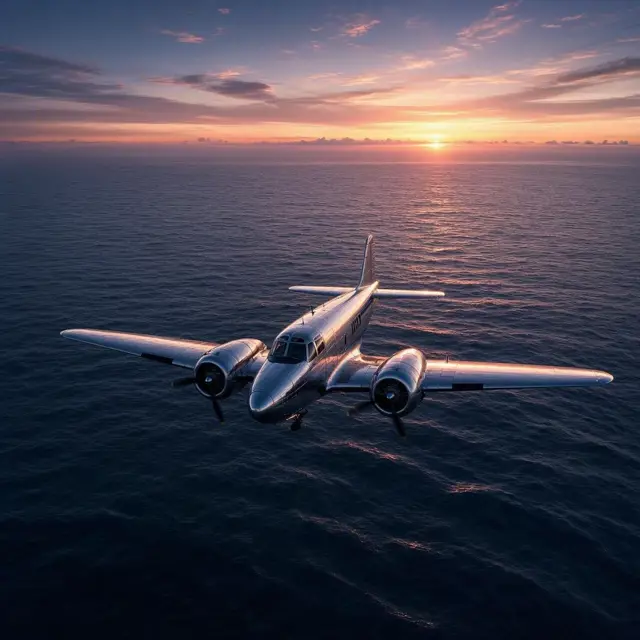
In 1937, Earhart set out to become the first woman to fly around the world. Her route roughly followed the equator, which would make it the longest round-the-world flight yet, at 29,000 miles. She flew a Lockheed Electra 10E with her navigator, Fred Noonan.
On 2 July 1937, they took off from Lae Airfield, heavily loaded with fuel. Their target was Howland Island, a tiny, flat strip of land in the middle of the Pacific, only about 2,000 metres long and 3 metres high, and more than 4,000 kilometres away.
A US Coast Guard ship, the Itasca, waited near the island to guide them by radio. The ship could hear Earhart clearly, but she could not hear the ship. At one point, she whistled into her microphone so the crew could try to work out her direction.
Between 7:30 and 7:40 in the morning, the ship's log noted she had only half an hour of fuel left. At 7:58, she said she still could not hear the ship, though her signal was so strong she must have been very close. After a final message about the line she was flying along, all contact was lost.
A Mystery That Never Ended
The US Navy and Coast Guard launched a search costing 4 million dollars, the most expensive and intensive in American history up to that time. No trace of Earhart, Noonan or their plane was found.
The official conclusion was that the plane ran out of fuel and crashed into the ocean, and most historians agree. Several things probably went wrong: Earhart had very little training on her new radio direction finder, and the ship and the plane were using time systems set half an hour apart.
Other theories have never gone away. Some believe she landed on Nikumaroro, then called Gardner Island, but many expeditions have found no definite link. Others claim she was captured by Japanese forces.
Modern searches keep coming up empty. Deep-sea sonar searches in 2003 and 2006 found nothing, and neither did an expedition led by the ocean explorer Robert Ballard in 2019, or another in 2024.
Earhart was declared legally dead on 5 January 1939. Since her disappearance, she has become a global cultural figure.