A House Worth Painting
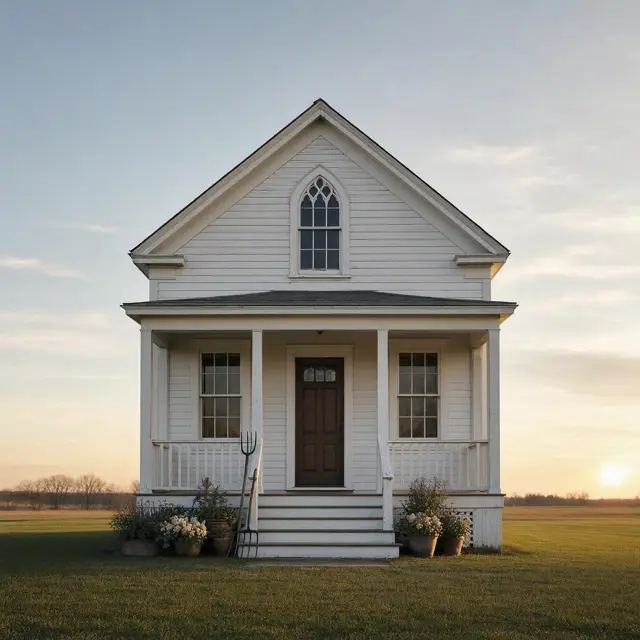
In August 1930, painter Grant Wood was driving through the small town of Eldon, Iowa, when a modest white cottage stopped him cold. Its upper window wore a pointed Gothic arch — a flourish of "borrowed pretentiousness", Wood thought, on a simple frame house built in the Carpenter Gothic style. He found it irresistibly paintable.
Wood sketched the house and decided to add "the kind of people I fancied should live in that house". For the stern woman he recruited his sister, Nan Wood Graham, who hand-sewed her colonial-print apron using rickrack trim rescued from their mother's old dresses because stores no longer sold it. For the man he chose his 63-year-old dentist, Dr. Byron McKeeby, and armed him with a three-pronged pitchfork.
Husband and Wife? Ask the Sister
The painting entered the Art Institute of Chicago's 1930 competition, where one judge dismissed it as a "comic valentine". A museum patron championed it anyway; it took the bronze medal, a $300 prize, and — thanks to the same patron's lobbying — a permanent home in the Institute's collection, where it hangs today.
Then came the identity confusion. Newspapers captioned the pair "An Iowa Farmer and His Wife", and Nan — perhaps not thrilled at being married off to a man decades older — corrected everyone: her brother had painted a father and his daughter. Wood himself stayed vague for years before confirming it in writing in 1941: "The prim lady with him is his grown-up daughter." The debate still flickers among viewers who assume they're a couple.
Iowa Was Not Amused
When the image ran in the Cedar Rapids Gazette, Iowans erupted. They saw themselves caricatured as "pinched, grim-faced, puritanical Bible-thumpers" — one farm wife reportedly threatened to bite Wood's ear off. The painter, who had studied in Paris, protested his sincerity: "I had to go to France to appreciate Iowa." He later added, slyly, that the people who resent the painting are those who feel they resemble it.
Early critics read the picture as satire of rural narrow-mindedness, in the vein of the era's small-town literary takedowns. But as the Great Depression deepened, the same two faces transformed into something else entirely: an emblem of steadfast American pioneer spirit. Wood leaned into the shift, declaring that all his best ideas came to him "while I was milking a cow".
The Most Parodied Painting in America
Look again and the painting is a quiet geometry lesson: the pitchfork's three tines repeat in the seams of the man's overalls, in the pointed arch of the window, even in the long shape of his face. Every vertical reinforces the Gothic theme. Some art historians go further — one reads the closed curtains in the window as a Victorian mourning custom, making the picture a memorial portrait; another connected the pair to Roman gods, noting the weather vane's globe and the fact that the planet Pluto was discovered in 1930.
Meanwhile the masses simply adopted it. *American Gothic* has been parodied endlessly — *The Simpsons*, *The Rocky Horror Picture Show*, Broadway, Google ads — arguably more than any other American artwork. The painting left the United States for the first time only in 2016, for exhibitions in Paris and London. The dentist and the sister, meanwhile, achieved a strange immortality neither posed for.