The Boy Who Could Not Sit Still
Ansel Adams was a difficult pupil. Born in San Francisco on 20 February 1902, he was hyperactive, often sick, and was dismissed from several private schools for being restless and inattentive. When he was twelve, his father simply removed him from school altogether.
For the next two years he was taught by private tutors, his aunt Mary and his father. He eventually finished his formal education at a small private school, graduating from the eighth grade on 8 June 1917. In later life he hung that diploma in his guest bathroom.
One of his earliest memories was watching smoke from the fires after the 1906 San Francisco earthquake. He was four. An aftershock three hours later threw him face-first into a garden wall, breaking his nose. It stayed crooked for the rest of his life and left him breathing through his mouth.
A Camera at Fourteen, in Yosemite
Adams had little patience for games or sport, but he loved being outdoors. As a boy he collected bugs and explored the cliffs and creeks near his family's home above the Golden Gate, which he described as San Francisco's wildest and rockiest coast.
At fourteen, on his first visit to Yosemite National Park, he was given his first camera. The two things that would define his life, the mountains and the lens, arrived at the same moment.
He developed his early photographic work as a member of the Sierra Club, the conservation organisation, which gave him both subject matter and a cause. He later took a contract with the United States Department of the Interior to photograph national parks, turning the thing he loved into the work he was paid for.
Sharp Focus and the Zone System
Adams helped found Group f/64, an association of photographers who argued for "pure" photography. Their creed was sharp focus and the use of the full tonal range of a print, in deliberate opposition to the soft, painterly style then in fashion.
Then he and Fred Archer built a method to deliver it. The Zone System is a way of making an image by understanding, in advance, exactly how the tones in the final print result from three choices: exposure, development of the negative, and printing.
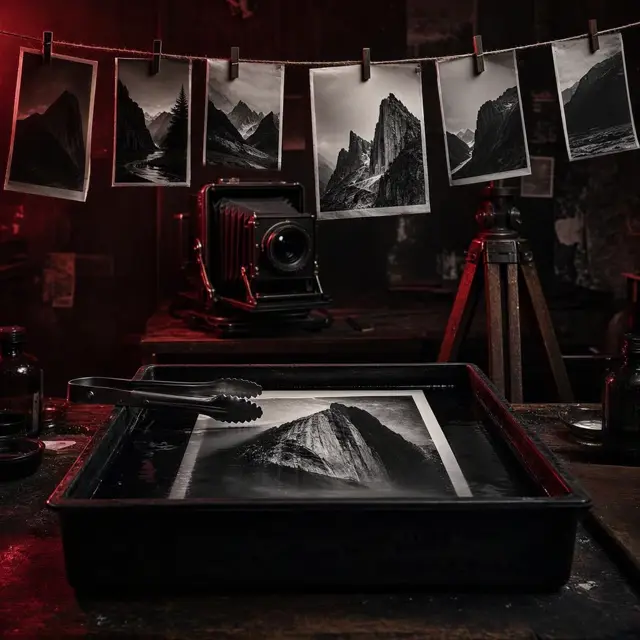
That is the quiet radicalism of his work. A photograph that looks like a lucky moment of light on granite is in fact an engineered object, planned backwards from the print the photographer intends to hold. He made the darkroom part of the composition, not an afterthought.
The Camera as Argument
Adams was a lifelong advocate for environmental conservation, and his photography was inseparable from that advocacy. The pictures were not only beautiful, they were evidence, used to argue that these places deserved protection.
It worked. His images and his persistent campaigning helped expand the National Park system, and in 1980 he was awarded the Presidential Medal of Freedom for that work.
He also fought to have photography itself taken seriously. He was a key advisor in founding the photography department at the Museum of Modern Art in New York, a landmark moment for the medium's institutional legitimacy, and he helped stage that department's first photography exhibition. He helped found the magazine *Aperture*, and co-founded the Center for Creative Photography at the University of Arizona. He died on 22 April 1984.