The Crown, the Bath and Eureka
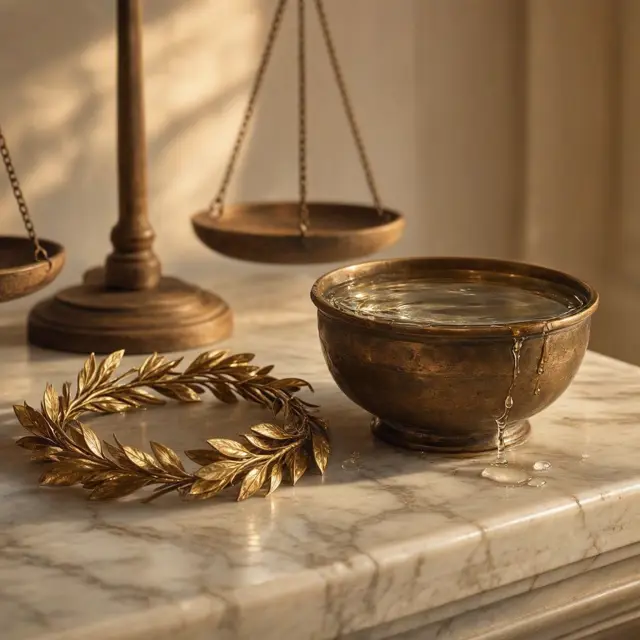
King Hiero II of Syracuse had a problem. He had given a goldsmith pure gold to make a golden wreath for a temple. Then he began to suspect the smith had swapped in some cheaper silver and kept part of the gold. The smith would not confess, so the king asked Archimedes to find out.
According to Vitruvius, writing about two centuries later, the answer came while Archimedes was stepping into a bath. He noticed that the water rose higher the lower he sank. He realized this could measure the crown's volume. He was so excited that he ran into the streets without dressing, crying “Eureka!”, which means “I have found it!”
Archimedes then took a lump of gold and a lump of silver, each the same weight as the wreath. He placed each one in the tub. The wreath pushed aside more water than the gold, but less than the silver. That showed it was gold mixed with silver.
A Smarter Test, and Galileo's Guess
Not everyone tells the story the same way. A Latin poem from the 5th century describes a neater method. The gold and silver were placed on the two sides of a balance, and then the whole thing was lowered into water. Because gold and silver have different density, the balance would tip.
This version uses the idea now known as Archimedes' principle, from his book On Floating Bodies. It says that an object placed in a fluid is pushed up by a force equal to the weight of the fluid it moves aside. That upward push is called buoyancy, and it explains why things float.
Centuries later, Galileo Galilei built a hydrostatic balance in 1586, inspired by Archimedes. Galileo thought it “probable” that this balance method was the one Archimedes really used. His reason was that it was very accurate and rested on discoveries Archimedes himself had made.
Moving Ships and Defending a City
One story says Archimedes boasted to King Hiero that he could move any large weight, so the king challenged him to move a ship. Other accounts say Archimedes launched the Syracusia, said to be the largest ship built in classical antiquity. Writers disagree on how he did it. Some credit pulleys, others the power of the lever.
That is where one of his most famous lines comes from: “Give me a place to stand on, and I will move the Earth.” These stories contain many unlikely details, though. Even the water-lifting device called Archimedes' screw probably existed long before he did.
His biggest fame in ancient times came from defending Syracuse against the Romans, starting in 214 BC. Historians describe improved catapults and cranes with an iron claw that lifted enemy ships out of the water and dropped them back so they sank. A later tale says he set ships on fire with mirrors, but it has been doubted since the Renaissance.
Counting Sand and Pinning Down Pi
Archimedes loved hard problems. He showed that pi is greater than 223/71 and less than 22/7, which is roughly between 3.1408 and 3.1428. He also worked out the area of a circle and the surface area and volume of a sphere, using methods that came close to modern calculus.
In a book called The Sand Reckoner, he asked how many grains of sand it would take to fill the universe. To answer, he built a new way of writing very large numbers, based on powers of the myriad. His answer, in modern terms, was an 8 followed by 63 zeros.
He also studied the Ostomachion, a puzzle of 14 pieces that fit together into a square, similar to a Tangram. In 2003, a Stanford scholar worked out that the pieces can form a square in 17,152 ways. Archimedes even set the mathematicians of Alexandria a cattle-counting problem whose harder version was first solved in 1880. The answer has over 200,000 digits.
Lost Books Hidden Under Prayers
For centuries, some of Archimedes' writings were thought to be lost forever. Then in 1906, the Danish professor Johan Ludvig Heiberg examined a 174-page goatskin book of prayers from the 13th century in Constantinople. He confirmed it was a palimpsest, a document written over an older text that had been scraped away.
Underneath were 10th-century copies of lost works by Archimedes. The book held seven of his treatises, including the only known source of The Method of Mechanical Theorems. In 1998, it sold at auction for $2.2 million. Researchers later used ultraviolet and X-ray light to read the hidden text.
His name still turns up in surprising places. “Eureka!” is the state motto of California, where it refers to the gold found near Sutter's Mill in 1848. The first seagoing steamship with a screw propeller, launched in 1839, was named the SS Archimedes. There is even a crater on the Moon named after him.