An Iron Crystal Blown Up 165 Billion Times
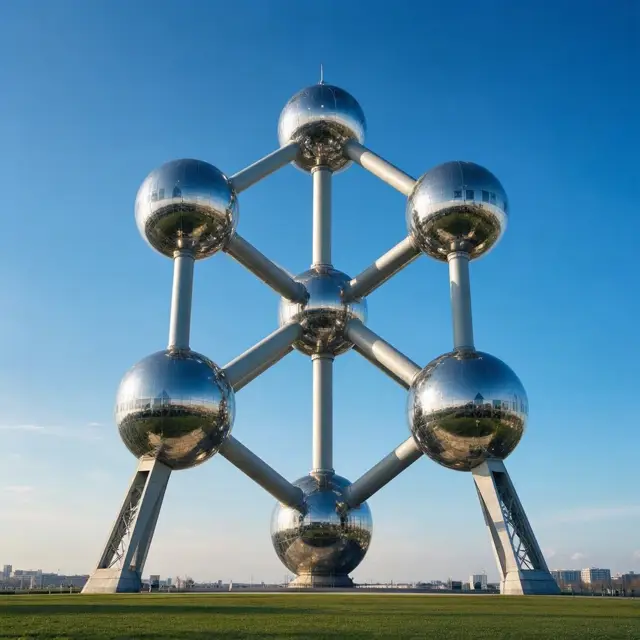
Imagine a tiny speck of iron, far too small to see, made 165 billion times bigger. That is the Atomium in Brussels. Its nine spheres, each 18 metres wide, are arranged like a unit cell of an iron crystal. The whole thing stands 102 metres tall, making it one of the tallest structures in Belgium.
The pattern is called body-centred cubic. Picture a cube with a sphere on each of its eight corners and one more right in the middle. Tubes 3 metres wide run along the cube's twelve edges and from every corner to the centre. Inside these tubes are stairs, escalators and a lift.
It was the centrepiece of the 1958 Brussels World's Fair, known as Expo 58. Engineer André Waterkeyn and architects André and Jean Polak designed it as a tribute to scientific progress and Belgian engineering. The name is a portmanteau of atom and aluminium, the metal that first covered the spheres.
Built to Last Six Months
The Atomium was never meant to stay. It was designed to last just six months. Waterkeyn presented the first plan in January 1955. Work on the foundations began in March 1956, and the building was finished less than a month before Expo 58 opened on 17 April 1958.
Then something nobody planned happened. People loved it. Its popularity made it a major part of the Brussels landscape. So its demolition was pushed back year after year, until the city decided to keep it for good.
Keeping it did not mean caring for it. For thirty years, very little maintenance work was done. Still, the building kept starring as a backdrop for big events. In 1960, the Tour de France passed in front of it during its opening stages. From 1960 to 1962, the Brussels Motor Grand Prix car race was held nearby. Today it is the city's most popular tourist attraction, with over 600,000 visitors a year.
Why Three Spheres Stay Closed
Only six of the nine spheres have ever been open to the public. These are the three on the central line and the three on the lower outer edges. The three upper outer spheres have no vertical support. For safety, they stay closed to keep foot traffic out of them.
The original design was even bolder. The whole structure was meant to rest on the single bottom sphere, with no legs at all. Then wind tunnel tests showed it would topple over in an 80 km/h wind. Belgium has recorded winds of up to 140 km/h. So support columns were added under the three lower outer spheres.
The central tube held Europe's fastest lift when it was built, moving at 5 metres per second. It carries 22 people to the top in just 23 seconds. The escalators in the slanted tubes are among the longest in Europe, with the longest one stretching 35 metres.
A Shiny New Skin and Sleepovers
By the year 2000 the building was in poor shape. A full renovation began in March 2004, and the Atomium reopened to the public on 18 February 2006. The faded aluminium panels were swapped for stainless steel. Stainless steel is mostly iron, so the giant model of iron is now covered in iron.
The spheres also learned to glow. LED lights were built into steel plates along the curved lines of each sphere. At night they can flash all at once or in turns, a nod to an electron moving around its core. The renovation cost 26 million euros. To help pay, pieces of the old aluminium were sold as souvenirs. A triangle about 2 metres long went for 1,000 euros.
Inside, over half the building holds exhibitions about Belgium and digital arts. Several spheres host concerts, film screenings and parties. One is a kids' sphere, where children aged six to twelve can join workshops and even spend the night.
The Landmark You Could Not Share
For years, the Atomium came with an odd rule. SABAM, Belgium's copyright collecting society, claimed worldwide rights over every picture of it. In 2003, it demanded that a US website remove all its Atomium images. The owner replaced them with a warning not to take photos of the Atomium at all.
In 2008, the 50th anniversary of Expo 58 brought a playful protest. Organisers asked people to send in their old Atomium photos and invited 100 photo editors to paint over the spheres. SABAM then made an exception for that year only. People could publish private photos for one year, as long as they were not for commercial use.
The real fix came from a new law. In June 2016, Belgium enacted freedom of panorama. It finally allowed pictures of the Atomium, and of other public buildings still under copyright, to be shared legally. So a holiday photo of the most popular sight in Brussels can now be posted without asking anyone first.