A Library in One Lifetime
Avicenna is believed to have written about 450 works. Around 240 of them survive, including 150 on philosophy and 40 on medicine. He also wrote on astronomy, alchemy, geography, geology, psychology, logic, mathematics and physics. Almost half of his works are in verse.
His name was Ibn Sina, and he lived from about 980 to 1037. Avicenna, the name used in the West, is simply a Latin form of it. It shows he came from a line going back to a man called Sina, his great-great-grandfather. He wrote mostly in Arabic, the language of science in his world, but also wrote key works in Persian. His poetry came in both languages.
His thinking followed the Peripatetic school, which grew out of Aristotle's ideas, and he is seen as one of its greatest voices in the Muslim world. Science historian George Sarton called him one of the greatest thinkers and medical scholars in history.
A Teenage Court Doctor
Avicenna was born around 980 in the village of Afshana, near the city of Bukhara in Transoxiana. His family soon settled in Bukhara, a center of learning. His parents saw early that he was brilliant and hired tutors for him.
He learned fast. By age 10 he had memorized the entire Quran. He learned arithmetic from an Indian greengrocer. Later, a physician and philosopher named al-Natili came to the house to teach him. After Avicenna read Ptolemy's Almagest and Euclid's Elements, al-Natili told him to carry on his studies alone.
By 18 he was well trained in the Greek sciences. Even earlier, at 17, he became a physician to the ruler Nuh II. Under the Samanid rulers, he had access to great libraries in cities such as Balkh, Rey, Isfahan and Hamadan.
Writing on the Move
Avicenna's adult life was full of moves. He went to Gurganj, possibly in 999, the year the Samanid Empire fell, and later headed west. He once traveled to meet the ruler of Gorgan, only to find the ruler had already died. In Ray he became court physician. In Hamadan, a ruler named Shams al-Dawla made him his vizier.
His work never stopped. While hiding in a patron's house, he finished The Book of Healing, writing 50 pages a day. Soon after, he was locked up for four months in the fortress of Fardajan, outside Hamadan. He kept writing there too.
Freedom came when a new ruler, Ala al-Dawla, took Hamadan. Avicenna moved to Isfahan, where he was well received. Historian Peter Adamson calls this the most stable period of his life. In 1037, while traveling with Ala al-Dawla, he fell ill with severe colic, a pain he had suffered all his life. He died soon after in Hamadan, where he was buried.
The Canon of Medicine
His most famous book is The Canon of Medicine, a medical encyclopedia in five volumes. The first covers the general principles of medicine. The second lists medicines and their properties. The third deals with diseases and treatments, the fourth with keeping healthy, and the fifth with specific illnesses and their cures.
The Canon was ahead of its time. It suggested that invisible tainted organisms were linked to disease, and it advised keeping sick people apart to reduce the spread. Avicenna also recognized that tuberculosis was contagious and that disease could spread through water and soil. His careful study of the pulse earned him the title pioneer of pulsology.
The book became a standard text at many medieval European universities and stayed in use as late as 1650. From the early 14th to the mid-16th century, Europe ranked Avicenna alongside Hippocrates and Galen and called him the prince of physicians. The Canon still plays a role in Unani medicine today.
Floating Men and Rose Oil
While in prison, Avicenna wrote his famous floating man idea, a thought experiment about the self. Imagine being created all at once, hanging in the air, cut off from every sensation, not even touching your own body. Avicenna argued you would still know that you exist. For him, this showed that the soul is separate from the body.
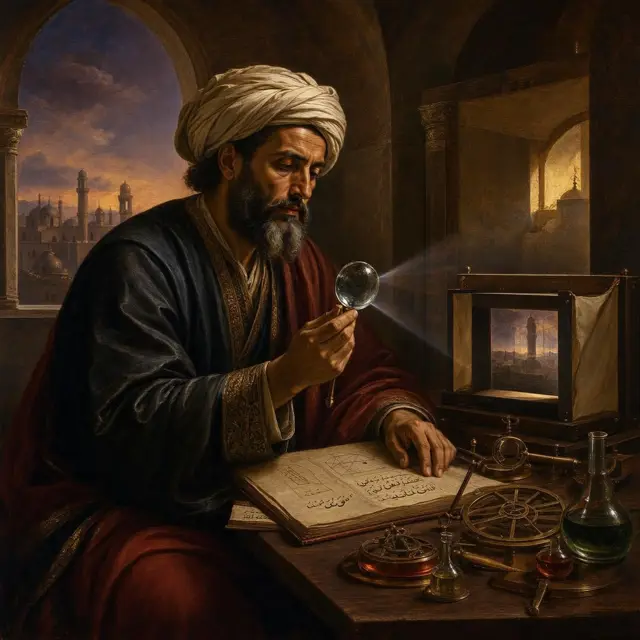
His curiosity reached far beyond medicine. He argued that light must travel at a finite speed. He explained that mountains form either when earthquakes push up the ground or when water carves out valleys over a long period of time. He also said the stars shine with their own light.
In chemistry, he was the first to get the scent of flowers by distillation. He used steam distillation to make essential oils such as rose essence, which he used to treat heart conditions. Today a crater on the Moon carries his name, and UNESCO gives an Avicenna Prize for ethics in science.