A School Built on One Radical Idea
The Staatliches Bauhaus opened in Weimar on 1 April 1919, founded by the architect Walter Gropius as a merger of a fine art academy and a school of arts and crafts.
Its founding idea was that the split between the artist and the craftsman was a snobbery worth destroying. In a pamphlet for an exhibition that same April, Gropius declared his goal was "to create a new guild of craftsmen, without the class distinctions which raise an arrogant barrier between craftsman and artist." The name he coined points both to building and to the Bauhütte, a premodern guild of stonemasons.
Underneath sat the notion of a *Gesamtkunstwerk*, a comprehensive artwork in which all the arts would eventually come together. What made it genuinely new was the refusal to treat mass production as the enemy of beauty. The school set out to unify individual artistic vision with the demands of the factory, and put function first.
Three Cities, Three Directors, Fourteen Years
The Bauhaus never sat still. It ran in Weimar from 1919 to 1925, Dessau from 1925 to 1932, and Berlin from 1932 to 1933, under three architect-directors: Gropius until 1928, Hannes Meyer from 1928 to 1930, and Ludwig Mies van der Rohe from 1930.
Every move changed the school. Focus, technique, staff and politics all shifted. The pottery workshop was simply discontinued in the move to Dessau, despite having been an important source of revenue.
The politics eventually caught it. In 1930 the mayor of Dessau, Fritz Hesse, dismissed Meyer after a scandal over the alleged use of school funds for communist causes, and appointed Mies, who turned the Bauhaus into a private school and barred Meyer's supporters. The Dessau campus was shuttered in 1932 once the Nazi party took over the local government of the Free State of Anhalt, and in 1933 the school was closed by its own leadership under Nazi pressure, having been painted as a centre of communist intellectualism.
What Bauhaus Actually Looks Like
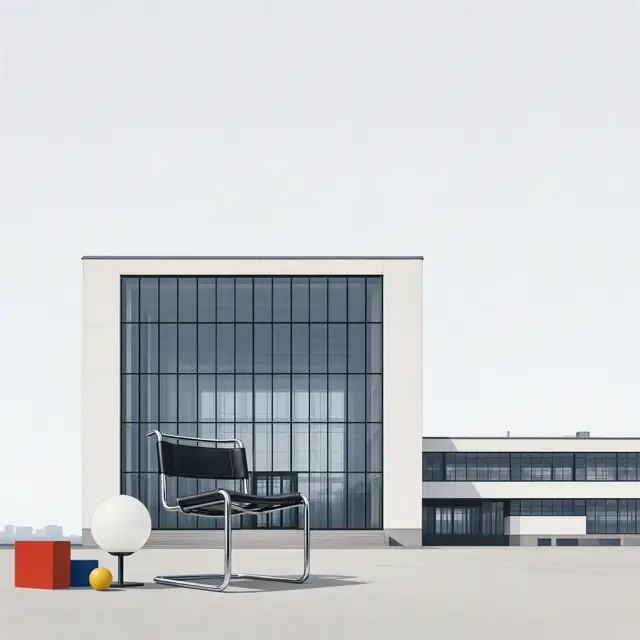
The look is easier to recognise than to describe, but it comes down to a short list of decisions. Simple geometric shapes such as rectangles and spheres, without elaborate decoration. Rounded corners, sometimes rounded walls, and curved chrome pipes. Buildings with protruding balconies, flat chunky railings facing the street, and long horizontal banks of windows.
The governing rule was the absence of ornamentation and a harmony between the function of an object or building and its design. That thinking owed a lot to the 19th-century English designer William Morris, who argued that art should meet the needs of society and that there should be no distinction between form and function.
The staff list explains the quality of the output. At various points it included Paul Klee, Wassily Kandinsky, Gunta Stölzl and László Moholy-Nagy, some of the most serious artists working in Europe at the time, teaching people who would go on to design ordinary household objects.
Closed in Berlin, Rebuilt Everywhere Else
Shutting the school down is precisely what spread it. Former key figures found success in the United States and became the avant-garde of what was later called the International Style.
The most concentrated result is not in Germany at all. The White City of Tel Aviv, where numerous Jewish Bauhaus architects emigrated, has the highest concentration of Bauhaus international architecture anywhere in the world.
The influence then leaked into nearly every discipline that shapes daily life: architecture, graphic design, interior design, industrial design and typography. It is worth noting the Bauhaus was not alone in trying this. The Vkhutemas, a Russian state art and technical school founded in Moscow in 1920, had close parallels in intent, organization and scope, and was actually the larger school. It was simply less publicised outside the Soviet Union, and so is far less familiar in the West.