Keeping Time With Old Pennies
One of the most famous clocks on Earth is adjusted with loose change. On top of its pendulum sits a small stack of old pre-decimal pennies. Adding a coin lifts the pendulum's centre of mass a tiny bit. That makes the pendulum swing slightly faster. One penny changes the clock's speed by 0.4 seconds a day.
Not every coin is a penny. In 2009, three of them were swapped for a £5 coin made for the 2012 London Olympics. In 2015, crews found the clock running seven seconds fast and took coins off. It then ran slow for a while.
The clock was designed by the lawyer and amateur horologist Edmund Beckett Denison and the Astronomer Royal, George Airy. Denison invented a new kind of escapement that kept the pendulum well separated from the rest of the mechanism, limiting the effects of wind, rain and snow on the dials. He never patented it, and it soon became the standard for good tower clocks. Today the clock is still wound by hand three times a week.
The Bell That Cracked Twice
Strictly speaking, Big Ben is the bell, not the tower. The first Great Bell weighed 16 tons and was cast in 1856. The tower was not finished yet, so the bell was tested in a yard nearby. It cracked beyond repair. A new 13.5-ton bell was cast in 1858. Sixteen horses pulled it to the tower through cheering crowds, and hauling it up to the belfry took 18 hours.
It first rang on 11 July 1859. By September, it had cracked too. The foundry's manager blamed Denison for using a hammer more than twice the maximum weight. For three years, the hours were struck on the lowest-sounding of the four quarter bells instead. The fix was clever. A square piece was cut out around the crack, and the bell was turned an eighth of a turn so the hammer hit a new spot.
The crack was never repaired, and Big Ben has rung with a slightly different tone ever since. The name may come from Sir Benjamin Hall, who oversaw its installation, or from a boxer called Big Ben.
Snow, Starlings and a Forgotten Hammer
Big Ben is famous for being reliable, which makes its rare stops even more fun. Its very first stop came from a heavy fall of snow on the hands. Snow stopped it several more times over the years. In 1955, small heaters were placed inside two of the dials, which has helped cut down on freezing.
The animals and workers have had their turn too. In 1936, a painter leaned a ladder against a shaft driving the hands and stopped the clock for over an hour. In 1941, a workman left a hammer too close to the mechanism, and the clock stood still from 10:13 at night to 10:13 the next morning. In 1949, a flock of starlings perched on the minute hand and slowed it by four and a half minutes.
On New Year's Eve 1962, ice on the hands caused the pendulum to unhook itself, as designed, to protect the machinery. The clock rang in 1963 nine minutes late. Yet it kept accurate time and chimed right through the Blitz.
A Tower With a Slight Lean
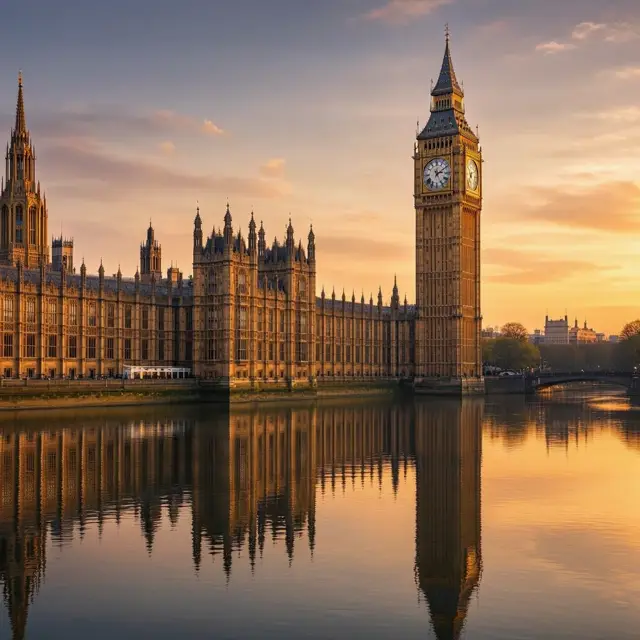
The tower, renamed Elizabeth Tower in 2012, was finished in 1859 in the Gothic Revival style. It stands 96 m tall. Reaching the belfry takes 334 steps, and there are 59 more to the top of the spire. Each clock face is 6.9 m across and holds 324 pieces of glass. It has been claimed that no two pieces in a dial are the same. The minute hands are 4.3 m long.
The ground below is soft London Clay, so the tower leans a little to the north-west, by about 500 mm at the very tip. Do not worry. Experts believe the lean will not be a problem for another 4,000 to 10,000 years.
Above the belfry sits the Ayrton Light, a lantern that shines whenever the House of Commons sits after dark. It once pointed toward Buckingham Palace so Queen Victoria could look out of a window and see if the Commons were at work.
Four Silent Years and a Blue Makeover
From 2017 to 2021, the bells went mostly quiet during a huge restoration. They were silenced to protect the hearing of the workers, since the striker hitting the bell is as loud as 110 to 115 decibels inside the tower. At least one clock face always stayed visible.
The work uncovered surprises, including asbestos, lead paint and old wartime damage. The budget grew from about £29 million to nearly £80 million. All 2,567 cast-iron roof tiles were restored, a lift was added, and the tower got its first toilet with running water.
The biggest change was colour. The dials had been painted black in the 1930s to hide soot. They were returned to their original Prussian blue, and all 1,296 pieces of dial glass were replaced. One fun trick still works: at the right distance, Londoners listening live and on analogue radio can hear the bell strike thirteen times, because radio beats the slow sound travelling through the air.