Twenty-One Elephants on Parade
On 17 May 1884, Jumbo the elephant led a parade of 21 elephants across the Brooklyn Bridge. It was a stunt by circus owner P. T. Barnum. It promoted his circus, and it also helped calm doubts about whether the new bridge was really stable.
Those doubts made sense. When the bridge opened on 24 May 1883, it was the longest suspension bridge in the world. Its main span stretched 1,595.5 feet (486.3 m), 20% longer than any built before. It was also the first fixed crossing of the East River. Until then, people moved between Manhattan and Brooklyn by ferry.
The opening was huge. Thousands of people came, ships filled the river and fireworks lit the sky. Emily Warren Roebling was officially the first to cross. That first day, 1,800 vehicles and 150,300 people went over. Within a week, ferry crews noticed a sharp drop in riders, while toll workers were handling over a hundred people a minute.
Running a Bridge From a Bedroom
The bridge was designed by John A. Roebling, a German immigrant engineer who had built other suspension bridges. He first proposed it in 1857. But he did not live to see work begin. In 1869, his 32-year-old son Washington took over as chief engineer.
The foundations were dug deep under the river inside giant boxes called caissons, kept dry with compressed air. Many workers got sick with caisson disease, now known as the bends. The project physician gave it that name. Washington Roebling fell ill with it too and could no longer supervise the work in person. So he directed the bridge from his apartment, watching "through a telescope from his bedroom."
His wife, Emily Warren Roebling, stepped in. She carried messages between him and the engineers on site. She also understood the maths of the catenary curve, the strength of materials and how cables are built. For the next 11 years, she helped supervise construction, doing much of the chief engineer's day-to-day work and project management.
The Great Wire Swindle
Four main cables hold the bridge up. Each is 15.75 inches (40 cm) thick and holds 5,282 steel wires, bundled into 19 strands. It was the first time this kind of bundling was used in a suspension bridge.
But there was a scandal hiding inside. The wire contract went to J. Lloyd Haigh, who was linked to a bridge trustee that Washington Roebling distrusted. Roebling's assistants later tested the wire and found Haigh had swapped in poor-quality wire. Of 80 rings tested, only five met standards. Haigh was estimated to have made $300,000 from the trick.
By then it was too late to replace the cables already built. Roebling worked out that the bridge would now be only four times as strong as needed, instead of six to eight times. So the bad wire stayed, and 150 extra wires were added to each cable. To avoid a public fuss, Haigh was not fired. Instead, he had to pay for the extra good wire himself.
Stone Towers Above the River
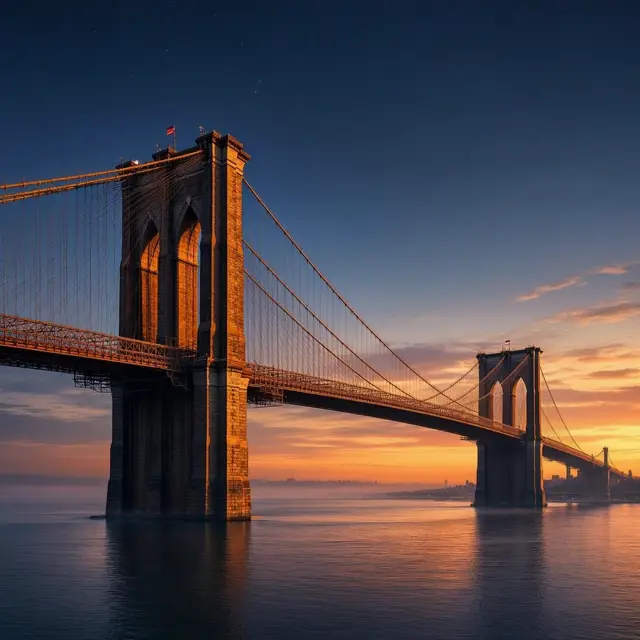
The two towers are built of limestone, granite and cement, and stand 278 feet (85 m) tall. The granite came from Vinalhaven Island in Maine and was shipped to New York by schooner. Each tower has a pair of pointed Gothic Revival arches that the roads pass through.
When they were finished, the towers were taller than every building in the city except one, and stayed that way until 1890. Building them took four years. Heavy stone blocks were pulled to the towers by steam-powered wire ropes and set in place by a crane on top.
Under the water, the towers rest on caissons made of yellow pine and filled with cement. In one accident, air pressure was lost and the half-built tower dropped down hard. The caisson took about 23 tons per square foot, more than four times its planned load, with only minor damage. The bridge also flexes, growing and shrinking 14 to 16 inches between hot and cold.
Walking the Bridge Today
A raised walkway runs down the middle of the bridge, 18 feet (5.5 m) above the car lanes. It narrows to 10 feet (3 m) where the main cables come down. Those tight spots are also some of the most popular places to take photos.
When the subway stops, the bridge becomes a lifeline. People walked across during transit strikes in 1980 and 2005, and during blackouts in 1965, 1977 and 2003. In 2003, so many walkers fell into step with each other that the bridge swayed. John Roebling had said it would sag but not fall, even if one of its three support systems failed.
It has seen some fun moments too. In 1919, a pilot flew one of the world's largest airplanes of the time under the bridge. Couples clip love locks to it, even though that is illegal and can bring a $100 fine. City workers remove them at a cost of $100,000 a year.