A Hotel on an Island Built From Scratch
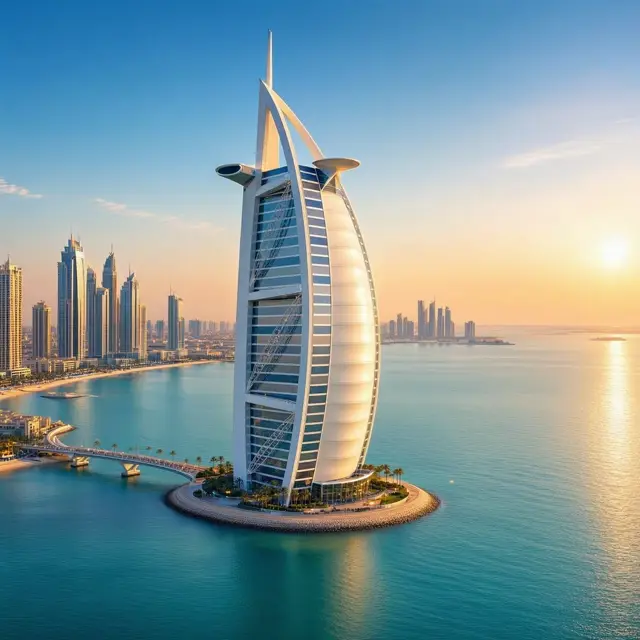
The Burj Al Arab does not stand on the beach. It sits on its own island of reclaimed land, 280 m (920 ft) offshore, linked to the mainland by a private curving bridge. Making that island took longer than making the hotel. Reclaiming the land from the sea took three years, while the building itself took less than three.
To hold the tower up, builders drove 230 concrete piles, each 40 metres long, into the sand. They then laid a surface of large rocks circled by a concrete honeycomb pattern to protect the foundation from erosion. The finished building holds over 70,000 cubic metres of concrete and 9,000 tons of steel.
The spot has a fun backstory. The beach was once called Chicago Beach. The name came from the Chicago Bridge & Iron Company, which once welded giant floating oil storage tanks on the site. Locals called those tanks Kazzans.
Designed to Look Like a Sail
The hotel's shape copies the sail of a dhow. The British firm Atkins designed it, with architect Tom Wright coming up with the iconic look. Two wings spread out in a V shape to form a huge mast, and the space between them is closed in to create a giant atrium 180 m (590 ft) tall.
One of its smartest features is its skin. A translucent fiberglass facade shields the inside from the desert sun during the day. At night, the same surface works as a screen that lights up after dark.
Building a skyscraper on soaked soil was new territory. Engineers had to run groundbreaking calculations covering how the soil and structure would interact, the effect of water, strong winds and even the load of the helipad. Work on the island began in 1994, with up to 2,000 workers on site at the busiest time. The hotel opened on 1 December 1999, with interiors by designer Khuan Chew.
Very Tall, Partly Empty
At 321 metres (1,053 ft), the Burj Al Arab is one of the tallest hotels in the world. But there is a twist: 39% of its total height is space that cannot actually be occupied. It ranks as the world's fifth tallest hotel. Its Dubai neighbor, the Rose Rayhaan, is just 12 m taller. If mixed-use buildings were left off the list, the Burj Al Arab would rank third.
Inside, there are no ordinary rooms. The hotel has 199 suites, and each one has eight dedicated staff members plus a 24-hour butler service. The smallest suite covers 169 square metres, and the largest covers 780 square metres.
The top-end Royal Suite was billed at US$24,000 a night. In 2012, CNN Go listed it at number 12 among the world's 15 most expensive hotel suites. The hotel is also very popular with travelers from China, who made up 25 percent of all bookings in 2011 and 2012.
The Busiest Helipad in the Sky
Near the roof, 210 m (689 ft) above the ground, sits a helipad designed by Irish architect Rebecca Gernon. It has had a far wilder career than most landing pads. It has been used as a car race track and as a boxing ring. Roger Federer and Andre Agassi played a tennis match on it. It also served as the jumping-off point for the highest kite surfing jump in history, and Red Bull athletes have staged stunts there.
The restaurants are just as dramatic. Al Muntaha sits 200 m (660 ft) above the Gulf, held up by a cantilever that reaches 27 m (89 ft) out from each side of the mast. Guests ride a panoramic elevator to get there.
Al Mahara takes the opposite direction. Diners reach it through a simulated submarine voyage. It features a seawater aquarium holding roughly 990,000 litres. The tank wall is made of acrylic glass about 18 cm thick to handle the water pressure.
The Seven-Star Label It Never Claimed
The Burj Al Arab is often called the world's only seven-star hotel. The hotel says it never claimed that. The label came from a British journalist who toured the building before it officially opened and found it beyond anything she had ever seen. A company spokesperson said they do not encourage the term and have never used it in advertising. Its official ratings are five stars, the highest given by both the Forbes Travel Guide and Dubai's tourism department.
The building has also become a pop culture star. It appears on the cover of the 2009 Owl City album Ocean Eyes. In the Chinese edition of The Amazing Race, teams had to clean a room to the hotel's standards. In an animated race show, contestants returned serves from a tennis robot on the helipad.
In April 2026, the hotel began its first major restoration, expected to last about 18 months. The plan is to modernize the interior while keeping its original look.