Taller Than Anything Ever Built
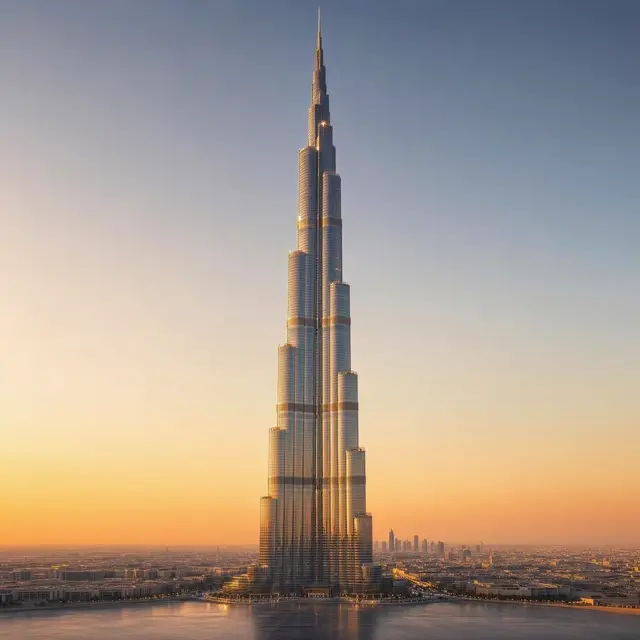
At 829.8 meters, the Burj Khalifa in Dubai is the tallest structure ever built. That is just over half a mile of concrete, steel and glass. It took the title of world's tallest building from Taipei 101 and has held it since 2011.
The records keep piling up. It has the most floors of any building, with 163. It holds the world's highest restaurant, on the 122nd floor at 442 meters. Its elevators travel the longest distance in the world, 504 meters, and it has the world's highest elevator, set inside a rod at the very top of the building.
It was called Burj Dubai until it opened in January 2010. During the opening, it was renamed in honour of Sheikh Khalifa bin Zayed Al Nahyan, then president of the United Arab Emirates. From the top, on a clear day at low tide, visitors can see the coast of Iran, about 153 km away.
A Desert Flower Made of Steel and Glass
The tower was designed by the Chicago firm Skidmore, Owings & Merrill, with Adrian Smith as chief architect. Its design draws on the traditional Islamic architecture of the region. The floor plan is shaped like a Y, with three wings around a strong central core. Like the park around it, the design was based on the flower of the Hymenocallis, a desert plant.
Smith found another idea close to home. While planning the project, he looked out his office window at Chicago's Lake Point Tower, with its curved three-wing layout, and thought, "There's the prototype." The Y shape was also chosen to make the best use of space for homes and hotel rooms.
The engineering secret is the bundled tube design of Chicago's Willis Tower, invented by Fazlur Rahman Khan. Thanks to this system, the tower used only about half as much steel, in proportion, as the Empire State Building. As it rises, the tower steps inward 27 times in a spiral. These setbacks slim the tower down and create handy outdoor terraces.
Beating the Wind Half a Mile Up
At this height, wind is a serious problem. Wind flowing past a tall tower can form swirling eddies and vortices that make it vibrate. The 27 setbacks are arranged to cut down this shaking. Even so, the very top of the tower sways a total of 1.5 meters.
The top is a spire made of more than 4,000 tonnes of steel. Its central pipe alone weighs 350 tonnes and stands 200 meters tall. Very little of the spire can actually be used, so it is widely seen as vanity height. Without it, the building would be 585 meters tall.
A study by the Council on Tall Buildings and Urban Habitat noted that the empty spire "could be a skyscraper on its own." If it stood in Europe, it would be the 11th tallest building on the continent. Up at the top, the outside air is thought to be about 6 °C cooler than at the base.
Concrete Poured at Night, With Ice
Building here was hard from the ground up. In 2003, engineers drilled 33 test holes and found "weak to very weak" sandstone and siltstone, all the way down to 140 meters. So the tower stands on 192 piles, each 1.5 meters wide and 43 meters long, buried more than 50 meters deep. This foundation supports a building that weighs about 450,000 tonnes.
Summer heat was another challenge, with temperatures that can reach 50 °C. Warm concrete can set too fast and crack. So in summer, workers added ice to the mix and poured it at night, when the air was cooler. A new super high-pressure pump pushed concrete up to 606 meters, a world record at the time.
Some of the steel has a surprising past. More than 35,000 tonnes of structural steel came from the Palace of the Republic in Berlin and was shipped to Dubai after that building was torn down in 2008. In all, the job used 330,000 cubic meters of concrete, 55,000 tonnes of steel rebar and 22 million hours of work.
Washing 24,348 Windows
Keeping the tower shiny is a job of its own. It has 24,348 windows, about 120,000 square meters of glass. Three tracks on the outside each carry a 1,500 kg cleaning machine. When everything is working, it takes 36 workers three to four months to clean the whole outside. Unmanned machines clean the top 27 tiers and the glass spire.
Getting around is fast too. The tower has 57 elevators, including the world's fastest double-deck elevators, moving at up to 10 meters per second. If you prefer walking, there are 2,909 stairs from the ground floor to the 160th floor. According to the developer, its 900 apartments sold out within eight hours.
Some visitors chose a faster way down. In 2014, French BASE jumpers Vince Reffet and Fred Fugen set a Guinness world record by leaping from a platform at the very top, 828 meters up. In 2011, climber Alain Robert scaled the outside all the way to the top of the spire in 6 hours, using a rope and harness to follow UAE safety laws.