A Workhouse Childhood
Sir Charles Spencer Chaplin Jr. (16 April 1889 – 25 December 1977) was an English comic actor, filmmaker, singer, film editor and composer who rose to fame in the era of silent film. His career spanned more than 75 years — from his childhood in the Victorian era until a year before his death.
The beginning was genuinely grim. His childhood in London was one of poverty and hardship: his father was absent, his mother struggled financially, and he was sent to a workhouse twice before the age of nine. When he was 14, his mother was committed to a mental asylum.
He began performing early, touring music halls, then working as a stage actor and comedian. At 19 he was signed to the Fred Karno company, which took him to the United States. It is worth holding both facts at once: the most recognisable figure in cinema history spent part of his childhood in institutions for the destitute.
The Tramp Arrives
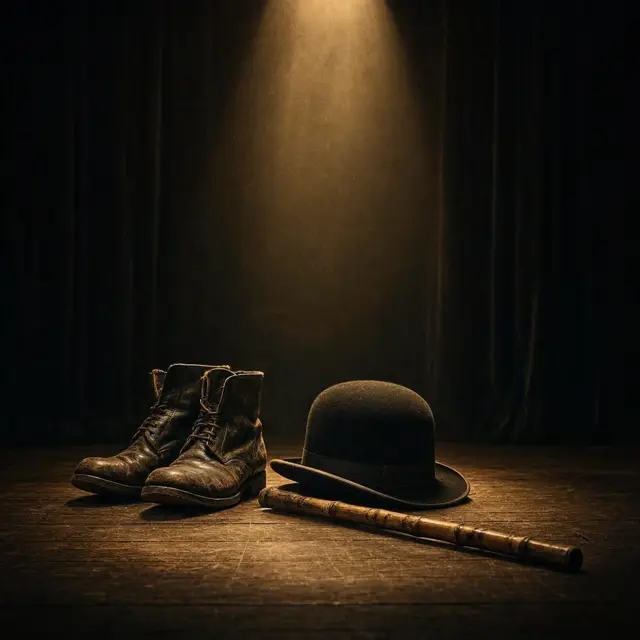
In 1914, Chaplin gained widespread popularity through his appearances in Keystone Studios films, and soon introduced the screen persona that would make him a worldwide icon: the Tramp.
He kept moving to get more control. He directed his own films at Essanay Studios, where the Tramp was developed emotionally in *The Tramp* (1915), then moved to Mutual and First National, attracting a large fanbase and demanding more money each time.
By 1918 he was one of the world's best-paid and best-known figures — at 29 years old, a decade after leaving the music halls. In 1919 he went further and co-founded the distribution company United Artists, which gave him complete control over his own films. That was the real prize, and it is why his work looks like one person's vision rather than a studio's.
Refusing to Talk
When sound arrived in the 1930s, Chaplin simply declined. He initially refused to move to sound films, producing City Lights (1931) and Modern Times (1936) without dialogue — silent films made years into the sound era, by choice.
His first sound film was The Great Dictator (1940), which satirised Adolf Hitler. A comedian who had spent two decades saying nothing chose Hitler as the reason to finally speak.
He worked as a total author: writing, directing, producing, editing and composing the music for most of his films. He was a perfectionist, and his financial independence let him spend years on a single picture. The films combine slapstick with pathos — the Tramp's struggles against adversity — and many carry social and political themes plus autobiographical elements drawn from that London childhood.
Forced Out of His Own Industry
The 1940s went badly. Chaplin's popularity declined rapidly amid controversy: he was accused of communist sympathies, and parts of the press and public were scandalised by a paternity suit and by his marriages to much younger women.
The FBI opened an investigation, and in 1952 Chaplin was forced to leave the United States. He settled in Switzerland. He abandoned the Tramp in his later films — *Monsieur Verdoux* (1947), *Limelight* (1952), *A King in New York* (1957), *The Chaplin Revue* (1959) and *A Countess from Hong Kong* (1967).
Recognition came back eventually, and late. In 1972, as part of a renewed appreciation of his work, he received an Honorary Academy Award for "the incalculable effect he has had in making motion pictures the art form of this century." He is still held in high regard, with *The Gold Rush*, *The Circus*, *City Lights*, *Modern Times* and *The Great Dictator* frequently ranked among the greatest films ever made.