The Spire Hidden Inside
In 1929, two New York towers were racing to be the world's tallest. The architect of 40 Wall Street kept raising his building, finally to 927 feet, just two feet above the planned height of the Chrysler Building. So the Chrysler's architect, William Van Alen, pulled a trick.
He got permission for a steel spire and had it built in secret inside the frame of the building. On October 23, 1929, one day before the Wall Street Crash, the bottom section was lifted to the top of the dome. Within 90 minutes, the rest was raised and riveted in place. Van Alen watched from the street and compared it to a butterfly leaving its cocoon.
The tower suddenly reached 1,046 feet. It passed 40 Wall Street and even the Eiffel Tower. It was the first structure built by people to top 1,000 feet, making it the world's first supertall skyscraper. Oddly, newspapers did not report the spire until days later.
Tallest for Just 11 Months
The win did not last. The Empire State Building's developer, John J. Raskob, worried that Walter Chrysler might "pull a trick like hiding a rod in the spire and then sticking it up at the last minute." That was close to what had already happened. Raskob kept adding height until his tower reached 1,250 feet. It opened on May 1, 1931, and the Chrysler's time as the world's tallest ended after 11 months.
The Chrysler still won in other ways. It remains the world's tallest steel-framed brick building. It also rented better. By 1935 it had leased 70 percent of its space, while the Empire State had leased only 23 percent and was nicknamed the "Empty State Building".
The tower was never the car company's headquarters. Walter Chrysler paid for it himself, as an investment for his children. He wrote that he built it "so that his sons would have something to be responsible for".
A Skyscraper Dressed Like a Car
Walter Chrysler made cars, and his building shows it. At each corner of the 31st floor sit giant ornaments shaped like the hood ornaments on Chrysler cars of the time. They also make the base look bigger. The same floor has a band of hubcaps and fenders, a signature of the building's Art Deco style. Higher up, eagle gargoyles sit on the 61st floor, and the 24th floor has 9-foot decorative pineapples.
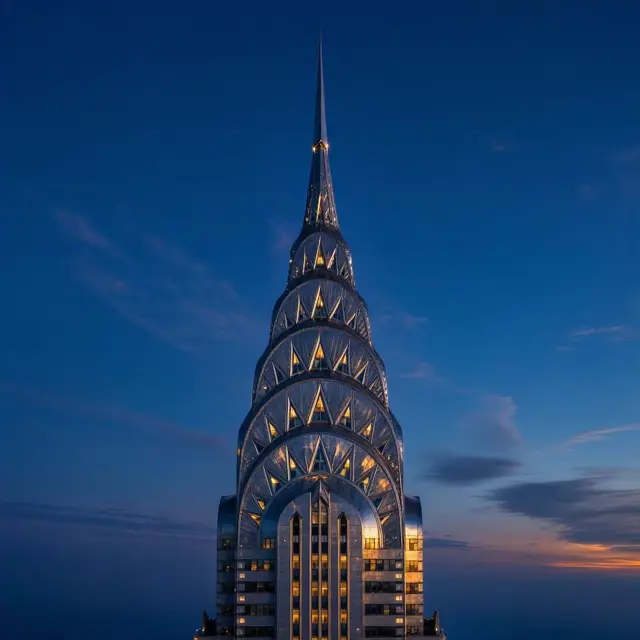
The famous crown is made of seven stacked arches covered in Nirosta steel. The steel is ribbed and riveted in a sunburst pattern with triangular windows, like the spokes of a wheel. Because the dome curves, the sheets had to be measured on site and shaped in workshops on the 67th and 75th floors.
At night, lights frame those triangular windows. Until 1998 they switched off at 2 am. Then a newspaper columnist convinced the owners to keep them on until 6 am.
Elevators Like Jewel Boxes
Inside, Chrysler ignored the extra cost of imported materials. The triangular lobby has walls of African red granite and floors banded with yellow travertine from Siena. Its ceiling holds a 110-by-67-foot mural celebrating energy and machines, including the airplane Spirit of St. Louis. Fifty figures on one wall panel were modeled on the workers who built the tower. Van Alen planned four big columns, but Chrysler removed them because they made the lobby look "cramped".
The 32 elevators are the real treasure. Each cab had its own unique mix of woods, and the cabs are seen as works of extraordinary marquetry. One writer called them "among the most beautiful small enclosed spaces in New York".
They were fast too. Chrysler wanted them to run at 900 feet per minute, even though city rules limited elevators to 700. The rule was loosened soon after the Empire State Building opened with its own high-speed elevators.
A Club in the Clouds
The top floors had their own surprises. The private Cloud Club filled the 66th to 68th floors from 1930. Members had to be elected and paid a $200 starting fee. It had an old English-style grill room, a dining room with a cloud painted on the ceiling, and a library with wooden walls. The club closed in 1979.
On the 71st floor sat an observation deck. For fifty cents, visitors walked a corridor hung with small glass planets. In the middle sat the toolbox Walter Chrysler used when he started out as a mechanic. Sadly, the small triangular windows made the view hard to enjoy. When the Empire State Building opened higher decks in 1931, the visitors left, and the deck closed in 1945.
Above that, the narrow top floors hold no offices at all. They house machinery, including the elevator motors and a 15,000-gallon water tank on the 73rd floor.