Built Because Skyscrapers Blocked the Signal
In the late 1960s, Toronto had an odd problem. New skyscrapers were going up downtown, and their shiny, reflective walls were hurting the quality of TV and radio signals. Broadcasters needed antennas at least 300 metres tall. In 1968, the Canadian National Railway came up with a bold fix: one giant tower that would also show off the strength of Canadian industry.
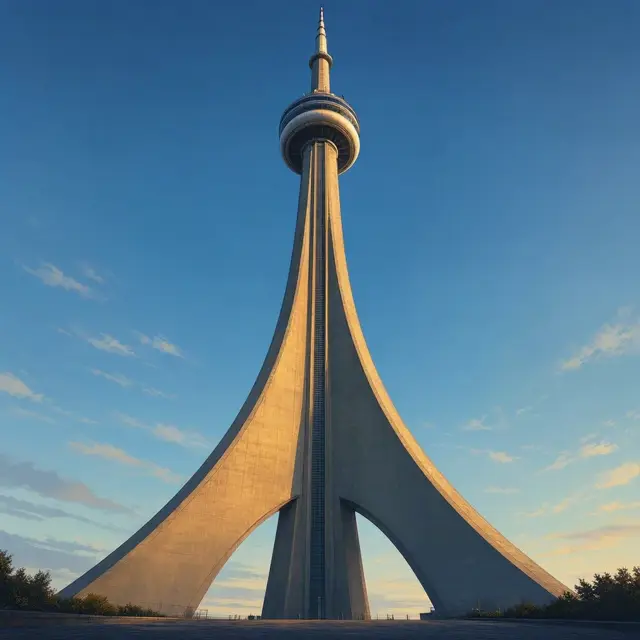
The first design looked very different. It was a tripod of three separate pillars joined by bridges, and it would have been much shorter. Over time it turned into today's single hexagonal core, with three legs blending into it to form a large Y shape at the ground.
The highest observation deck was a late addition. Developer Bud Andrews believed visitors would pay extra to go higher, so it was first nicknamed "Bud's Bubble". Around then, the team realized the tower could become the world's tallest free-standing structure, and they tweaked the plans to get there.
Concrete That Climbed Six Metres a Day
Construction began on February 6, 1973, with a huge hole. Workers removed 56,000 tonnes of earth and shale and poured a base 6.7 metres thick. That part took only four months.
Then came the clever bit. To build the main shaft, crews used a slipform, a large metal platform that jacked itself upward about 6 metres a day as the concrete beneath it set. All 40,500 cubic metres of concrete were mixed on site so every batch matched. By February 1974, the half-built tower was already the tallest structure in Canada.
How do you keep something that tall straight? The team hung giant plumb bobs from the slipform and watched them through small telescopes on the ground. It worked. Over its full height, the tower is only 29 mm away from perfectly vertical. On March 31, 1975, while still unfinished, it officially became the tallest free-standing structure in the world.
A Helicopter Named Olga
The antenna was supposed to go up by crane. Then luck stepped in. The United States Army sold a Sikorsky S-64 Skycrane helicopter to civilian operators, and it became available for the job. The helicopter, named "Olga", first removed the crane, then flew the antenna up in 36 sections.
The flights became a small tourist attraction of their own, and local newspapers printed the schedule. Olga finished the job in three and a half weeks instead of the planned six months. The tower was topped off on April 2, 1975, after 26 months of work, taking the height record from Moscow's Ostankino Tower.
There was one snag. Two years in, plans for the big Metro Centre development around the tower were scrapped. That left it alone on mostly empty railway land, which made it hard for tourists to reach. It opened anyway on June 26, 1976, and its CA$63 million cost was paid back in fifteen years.
Glass Floors and a Walk Around the Roof
The CN Tower is built for thrills. In 1994, a glass floor was installed 342 metres up. Its glass units are 64 mm thick and can withstand a pressure of 4.1 megapascals. In 2008, an elevator got a glass floor panel too, setting a world record for the highest one.
Since 2011, the EdgeWalk has let visitors walk all the way around the roof of the main pod, 356 metres up. Walkers are tethered to an overhead rail and move along a metal ledge just 1.5 metres wide. It is the world's highest full-circle, hands-free walk.
Just below, the 360 Restaurant turns a full circle every 72 minutes. When the tower opened, it even had a disco called Sparkles, billed as the highest dance floor in the world. Prefer stairs? There are 1,776 steps to the main deck, part of the tallest metal staircase on Earth. The fastest climb on record, set in 1989, took 7 minutes and 52 seconds.
The Tallest Thing That Isn't a Building
For 32 years, from 1975 to 2007, the CN Tower was the world's tallest free-standing structure, until Burj Khalifa in Dubai passed it. Some radio masts are taller, but they are held up by guy-wires, so they are counted separately. In 1995, the American Society of Civil Engineers named it one of the modern Seven Wonders of the World.
Oddly, it is not officially a building. Experts on tall buildings say a building must have floors, and the CN Tower does not have floors running continuously from the ground. That makes it a tower. After Burj Khalifa took the overall record, Guinness World Records certified the CN Tower as the world's tallest free-standing tower.
At night, 1,330 LED lights shine up the tower in changing colours, and they are turned off during spring and autumn bird migration. In 2018, falling ice from it punctured the roof of the nearby Rogers Centre stadium, and a baseball game was postponed.