A Race to the Sky
In the late 1920s, New York was in a race to build the world's tallest building. The press called it the "Race into the Sky". Two rivals, 40 Wall Street and the Chrysler Building, were already rising. In October 1929, the Chrysler Building added a 185-foot steel tip to its roof, jumping to 1,046 feet.
The Empire State team kept changing plans to stay ahead. The design grew from 50 stories to 60, then 80, then more. Investor John J. Raskob even worried that Chrysler might "pull a trick like hiding a rod in the spire and then sticking it up at the last minute."
So in December 1929, the plans changed one last time. They added a 200-foot metal crown and a mast for airships. The final plan was sketched within two hours, the night before it was due. In all, the design changed fifteen times.
A Floor a Day
Construction moved at a pace that still sounds unreal. The first steel went up in April 1930. During one stretch of 10 working days, builders added fourteen floors. They averaged four and a half stories a week, beating the old record of three and a half.
The secret was planning. Common parts like windows were mass-produced, and over 200 trucks delivered materials every day. A small railway inside the building carried carts of supplies to the elevators. Cafes and food stands opened on five unfinished floors, so workers did not have to go down for lunch. At its peak, the project had more than 3,500 workers.
The frame used 57,480 short tons of steel, the largest single steel order at the time. The structure was finished 410 days after construction began, and the final rivet was solid gold. The whole project even came in under budget.
Built to Dock Airships
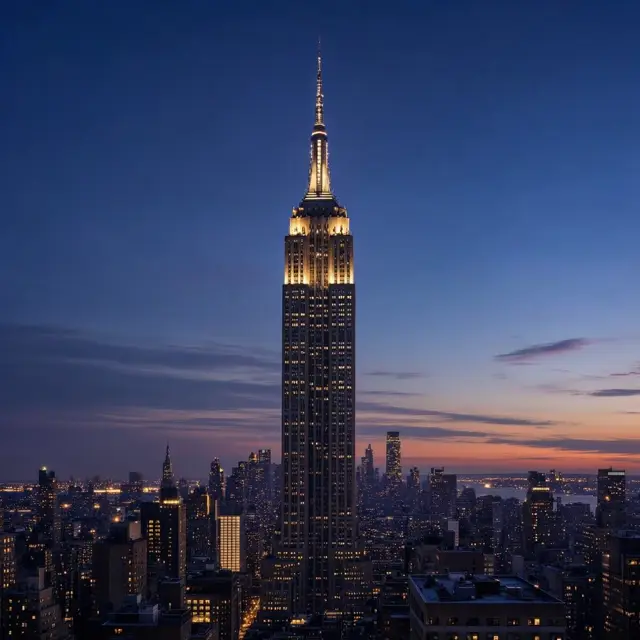
The famous spire was not just for looks. It was designed as a mooring mast where airships could tie up. Passengers would ride elevators from the 86th floor to a waiting room on the 101st floor, then climb stairs to a docking station on the 102nd. The airships would have been tied to the spire at about the height of a 106th floor.
There was one big problem. High winds at that height made docking impossible, so the plan was abandoned.
Today, the top level meant for airship passengers holds electrical equipment and an outdoor balcony. It is closed to the public, though celebrities are sometimes allowed up for photos. The mast also became the base of a broadcasting antenna. Now and then it even dresses up. A giant King Kong balloon was attached in 1983 for the character's 50th anniversary, and an inflatable dragon perched on it in 2024.
Limestone, Steps and Art Deco
The building is a classic of Art Deco, with mostly geometric decoration. Its outside is covered in Indiana limestone panels, which give it a blonde color. The facade also uses ten million bricks and holds 6,514 windows.
Its stepped shape came from a city rule. The 1916 Zoning Resolution required tall buildings to step back as they rose, partly so sunlight could reach the streets. These steps, called setbacks, appear at several floors, and the deepest one sits just above the fifth floor. Each setback lines up with the top of an elevator shaft.
Inside, the main lobby has two tones of marble and a zigzag floor pattern. Bronze panels above the doors show three trades used to build it: Electricity, Masonry and Heating. Behind the security desk, an aluminum image of the skyscraper shows rays spreading from its spire. Its 64 original elevators were designed to move at 1,200 feet per minute.
Sixteen Million Colors and 1,576 Steps
Since 1977, the top of the building has been lit in colors that match seasons, holidays and events. On nights when New York sports teams play at home, it shines in their colors, such as orange, blue and white for the Knicks. Organizations can even request a color through the building's website.
In 2012, the old lamps were replaced with 1,200 LED fixtures. That raised the number of possible colors from nine to over 16 million. Later that year, the building put on its first light show timed to music by Alicia Keys. The owners keep one firm rule: no advertisements in lights.
People also race up it. The Empire State Building Run-Up, held every year since 1978, climbs 1,576 steps to the 86th floor. The record is 9 minutes and 33 seconds, set by Australian cyclist Paul Crake in 2003. That works out to climbing 6,593 feet per hour.