Sent Home Sick, Then Came Back
Sir Ernest Henry Shackleton (15 February 1874 – 5 January 1922) was an Anglo-Irish Antarctic explorer who led three British expeditions south and became one of the principal figures of the Heroic Age of Antarctic Exploration.
He was born in Kilkea, County Kildare, Ireland, and moved with his family to Sydenham in suburban south London at the age of ten. His first taste of the polar regions came as third officer on Robert Falcon Scott's *Discovery* expedition of 1901–1904 — from which he was sent home early on health grounds, after he, Scott and Edward Adrian Wilson set a new southern record by marching to latitude 82° S.
Being invalided out could have ended it. Instead, on the Nimrod Expedition of 1907–1909, Shackleton and three companions reached a new Farthest South of 88°23′ S — just 97 geographical miles from the South Pole, and the largest single advance toward the pole in the history of exploration. Members of his team also climbed Mount Erebus, the most active Antarctic volcano. King Edward VII knighted him for it.
Ninety-Seven Miles and a Decision to Turn Back
That figure deserves its own pause. 97 geographical miles — about 112 statute miles, or 180 kilometres — is what separated Shackleton from being the first human at the South Pole.
He turned around. The pole would go instead to Roald Amundsen, whose conquest in December 1911 ended the race for good.
With the pole gone, Shackleton chose a harder target: crossing Antarctica from sea to sea, by way of the pole. He prepared what became the Imperial Trans-Antarctic Expedition of 1914–1917. It is worth noting how quickly the goalposts moved in this era — a man who had come within 180 km of the pole, and was knighted for it, found the achievement obsolete within two years and simply picked a bigger continent-spanning problem instead.
The Ship That Never Reached the Shore
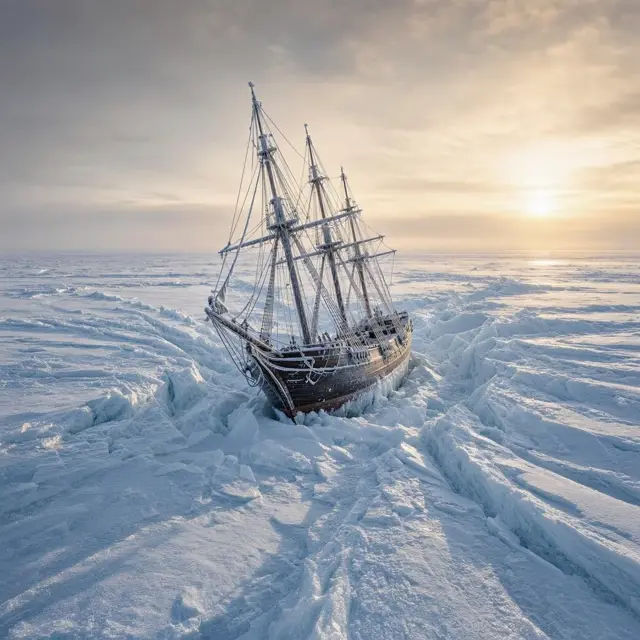
The expedition never began. Its ship, *Endurance*, became trapped in pack ice and finally sank in the Weddell Sea off Antarctica on 21 November 1915, before the crossing could start.
What followed is why Shackleton is remembered. The crew escaped by camping on the sea ice until it disintegrated beneath them, then launched the lifeboats to reach Elephant Island.
From there Shackleton undertook his most famous exploit: a stormy open-boat voyage of 720 nautical miles — 1,330 km — across the South Atlantic to the island of South Georgia, to fetch rescue. An objective failure became the greatest survival story in polar history, and the wreck of *Endurance* was finally located just over a century after Shackleton's death.
Broke, Forgotten, Then Rediscovered
Away from the ice, Shackleton's life was restless and unfulfilled. Searching for quick routes to wealth and security, he launched business ventures that failed to prosper, and he died heavily in debt.
He returned to the Antarctic on the Shackleton–Rowett Expedition in 1921 and died of a heart attack on 5 January 1922, aged 47, while his ship was moored at South Georgia. At his wife's request he stayed there, buried in Grytviken cemetery — left on the island rather than carried home.
The press praised him at his death, and then he was largely forgotten, while the heroic reputation of his rival Scott endured for decades. Later in the 20th century Shackleton was "rediscovered" and became a role model for leadership in extreme circumstances. Sir Raymond Priestley put the comparison best in 1956: "Scott for scientific method, Amundsen for speed and efficiency, but when disaster strikes and all hope is gone, get down on your knees and pray for Shackleton." In 2002 a BBC poll voted him the eleventh Greatest Briton.