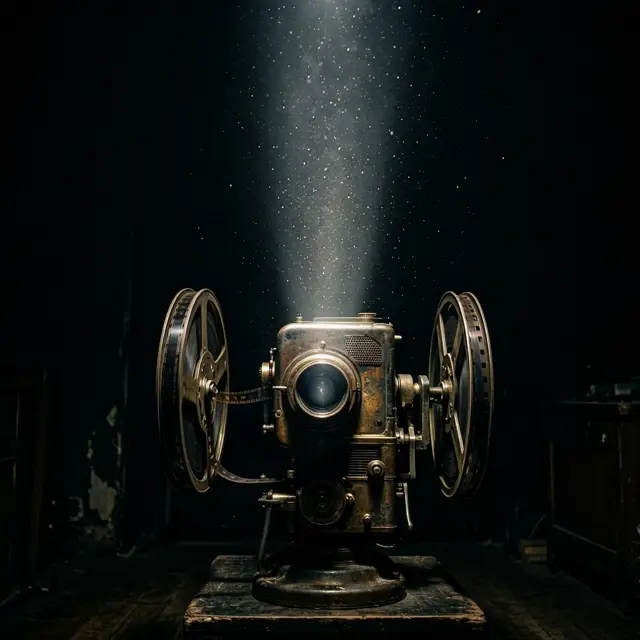
The Illusion Behind Every Movie
Every film you have ever watched is made of still pictures. A movie is a series of individual frames, and when they are shown rapidly one after another, the viewer sees motion that is not really there.
You do not notice the flicker between frames either. That effect was traditionally called persistence of vision and is now more precisely known as flicker fusion: the visual system blends a fast enough stream of pictures and gaps into one steady image.
Since the 1930s, most films have also been synchronised with sound. Film is widely considered an important art form that entertains, educates and inspires. Its visual language needs no translation, which gives it a universal reach, and dubbing or subtitles can carry the dialogue anywhere. Films are also cultural artifacts: they reflect the societies that make them, and they shape those societies in return.
Toys That Taught Pictures to Move
Cinema did not appear from nowhere. It drew on oral storytelling, theatre and visual art, and on older ways of showing moving or projected images: shadow puppetry, the camera obscura and the magic lantern.
The key principle arrived as a toy. In 1833 the stroboscopic disc, better known as the phenakistiscope, showed that quickly swapped drawings could appear to move. The idea spread through the zoetrope from 1866, the flip book from 1868 and the praxinoscope from 1877, and it became the basic principle of cinematography.
Photography, introduced in 1839, was at first far too slow to catch anything moving. Then in 1878 Eadweard Muybridge set a line of cameras along a track and captured a running horse in sequence, publishing it as *The Horse in Motion*. He and others went on to make many more chronophotography studies of motion.
The Year People First Paid to Watch
Before cinemas existed, people were already queuing. In 1886 Ottomar Anschutz developed the Electrotachyscope, which showed short looping motion scenes from 24 glass photographs on a hand-cranked wheel at about 30 frames per second. Nearly 34,000 people paid to see it at the Berlin Exhibition Park in the summer of 1892.
The real starting gun was 1895. That year saw the first public film screenings where admission was charged, by the American Woodville Latham and his sons, by the German brothers Emile and Max Skladanowsky, and by the French brothers Auguste and Louis Lumiere.
The Lumieres became the most famous of all. Their early films include *Workers Leaving the Lumiere Factory* (1895), a fixed camera watching employees walk out through a gate, and *L'Arrivee d'un train en gare de La Ciotat* (1896). After their success in France, the brothers toured the continent showing films to paying crowds.
When the Pictures Learned to Talk
For decades, films were silent. Bringing in sound took a technical push and a financial gamble. The Vitaphone system, developed alongside Bell Telephone Company and Western Electric, met resistance at first because equipping cinemas for it was expensive.
Audiences settled the argument. Sound in cinema gained acceptance with films like *Don Juan* in 1926 and *The Jazz Singer* in 1927, and synchronised sound became the norm for most films from the 1930s onward.
Sound even fixed the speed of film itself. The rate of 24 frames per second was chosen because it was the slowest, and therefore cheapest, speed that still delivered good enough sound quality. That compromise, made for practical reasons nearly a century ago, is still the standard look of cinema today.