A Skyscraper Shaped Like a Clothes Iron
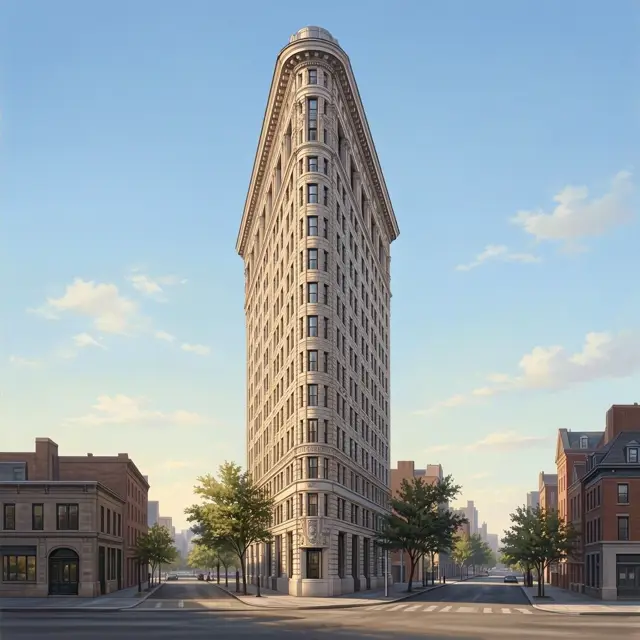
The Flatiron Building rises 22 stories on a triangle of land where Fifth Avenue and Broadway meet East 23rd Street in Manhattan. The odd site exists because Broadway cuts diagonally across the city's street grid. The name comes from the shape, which reminded people of a cast-iron clothes iron.
At its northern tip, the tower is only about 6 feet (1.8 m) wide, and its two long sides meet at an angle of about 25 degrees. Here is a fun twist: the site is actually a scalene right triangle, while a real flatiron is shaped like an isosceles triangle.
The building opened on 1 October 1902. It was designed by Chicago architect Daniel Burnham, with his designer Frederick P. Dinkelberg handling the details. Officially it was named the Fuller Building, after the founder of the company that built it. Locals kept calling it the Flatiron anyway, to the annoyance of its owners, and the nickname won.
Burnham's Folly and the Wild Winds
Early on, many New Yorkers expected the tall triangle to fall down. Critics argued that its shape and height together would topple it, which earned it the nickname Burnham's Folly. The Brooklyn Daily Eagle disagreed, calling the triangle the strongest of the geometric forms.
The engineers had done their homework. Corydon Purdy designed wind bracing that let the building withstand four times the wind force it could ever be expected to face. The frame holds 3,680 short tons of steel. The pieces were cut so precisely that, according to The New York Times, they fit together without changing a single bored hole.
The winds around the building were real, though. Air from the north split around it, and downdrafts and updrafts made gusts unpredictable, scattering paper bills from pedestrians' pocketbooks. Old films confirm the shape stirred up strong winds. For years people avoided walking on its side of the street, but those worries faded by the mid-20th century.
Built Like a Classical Column
Burnham designed the Flatiron as a tall Renaissance palazzo with Beaux-Arts styling. Its facade is split into three parts, like a classical Greek column: a base, a shaft and a top. The three-story base is clad in limestone, while the upper floors wear glazed terracotta made on Staten Island.
The details reward a close look. Terracotta panels show leaves, masks and wreaths, and the 17th story is decorated with lions' heads. Bay windows that stick out from the long sides, called oriels, run from the 7th to the 14th stories. They were rare in New York at the time but common in Chicago, where they were used to break up winds.
Not every piece was Burnham's idea. A small one-story shop at the tip, nicknamed the cowcatcher after the front of a train, was added at the owner's insistence. Burnham did not want it, because he believed it would ruin the symmetry of the prow.
Water-Powered Elevators and Pointy Offices
Until the end of the 20th century, the Flatiron ran on hydraulic elevators, powered by water. They had a reputation for being slow, and when their pipes burst, water often leaked into the cabs. By the time they were replaced, they were the last hydraulic elevators in New York City. To reach the 21st floor, people had to switch to a second elevator on the 20th.
Inside, the triangle created a maze of oddly shaped rooms. Offices at the tip, which tenants called the Point, were the most wanted. One publishing boss said his was the only office where you could stand in one place and see the East River, the Hudson and Central Park.
The tenant list was colorful too. Early on it included magazine publishers and music publishers, and the puppeteer Tony Sarg had a studio there in the 1910s. A penthouse added in 1905 was rented out as artists' studios.
A Star of Photos, Films and Auctions
The Flatiron may be one of the most photographed buildings in the world. Photographer Alfred Stieglitz saw it during a snowstorm and said it seemed to be moving toward him like the bow of a huge ocean steamer. Edward Steichen photographed it on a wet winter afternoon in 1904, as a tribute to Stieglitz's picture.
On screen, it served as the headquarters of the Daily Bugle, the newspaper where Peter Parker works as a photographer, in Sam Raimi's Spider-Man films. In 2014, Lego added a model of it to its Architecture series of landmarks.
Its recent story is just as wild. At a 2023 auction, a 31-year-old bidder won it for $190 million, then failed to pay the required $19 million down payment. A second auction followed. As of 2026, the old offices had been replaced with 36 homes, with apartments priced at $10.95 million and $50 million.