The Lamp Is the Least Interesting Part
Florence Nightingale, born 12 May 1820 and died 13 August 1910, is remembered as an English social reformer and the founder of modern nursing. She is also formally described as a statistician, and that is the half of her that got lost.
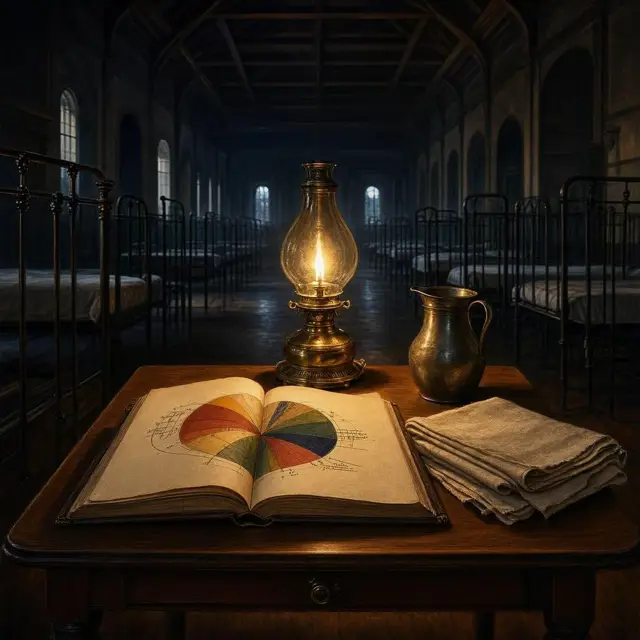
The icon came from Crimea. She served as a manager and trainer of nurses during the Crimean War, organising care for wounded soldiers at Constantinople, and significantly reduced death rates by improving hygiene and living standards. Victorian culture turned this into "The Lady with the Lamp", making ward rounds at night.
Her education explains a lot about what she did next. Her father held views on women's intellectual education that were advanced for his time and taught much of her curriculum himself, covering French, German, Italian, Latin, Greek, mathematics, constitutional history, grammar, composition, English literature and music. She was not a gifted amateur who wandered into nursing. She was a heavily trained mind who chose it against fierce family resistance.
Charts Built as Weapons
Nightingale was an innovator in statistics, and her particular insight was about presentation: she represented her analysis graphically to make conclusions and required actions impossible to miss.
Her signature device is the polar area diagram, now often called the Nightingale rose diagram, which is equivalent to a modern circular histogram. She used it to show the seasonal sources of patient mortality in the military field hospital she managed, so that the deaths from preventable causes were visible at a glance rather than buried in a table of numbers. She called a compilation of these diagrams a "coxcomb", although the term later drifted to mean the individual charts.
Credit needs a caveat she would probably have appreciated. She is frequently called the creator of the polar area diagram, but the form is known to have been used by André-Michel Guerry in 1829 and by Léon Louis Lalanne by 1830. Her achievement was not inventing the shape. It was using it as an instrument of persuasion, and the diagram is still regularly used in data visualisation today.
What Crimea Actually Proved
Recent commentators have asserted that Nightingale's Crimean War achievements were exaggerated by the media at the time. It is a fair criticism, and critics still agree on the importance of her later work in professionalising nursing roles for women.
What Crimea genuinely gave her was evidence. Her statistics from the war convinced her that non-medical approaches were more effective than medical ones, given the state of knowledge at the time, which pushed her toward sanitation and drainage rather than treatment.
She then spent that evidence on legislation. She campaigned on connection to mains drainage, work reflected in the strengthened Public Health Acts of 1874 and 1875. She also joined forces with the retired sanitary reformer Edwin Chadwick to persuade the minister Stansfeld to devolve enforcement powers to local authorities, deliberately breaking central control by medical technocrats. Historians now believe both drainage and her broader arguments mattered.
Building a Profession From Nothing
In 1860 Nightingale laid the foundation of professional nursing by establishing her nursing school at St Thomas' Hospital in London. It was the first secular nursing school in the world and is now part of King's College London.
The recognition attached to her name is unusual in its reach. New nurses take the Nightingale Pledge, the Florence Nightingale Medal is the highest international distinction a nurse can achieve, and International Nurses Day is celebrated annually on her birthday.
She was also a prodigious and versatile writer, and much of her published work aimed at spreading medical knowledge as widely as possible. Some of her tracts were deliberately written in simple English so that people with poor literacy could read them. Her reform work reached well beyond hospitals: improving healthcare across all sections of British society, advocating better hunger relief in India, helping abolish prostitution laws that fell harshly on women, and expanding what forms of work women were permitted to do. A great deal of her writing, including extensive work on religion and mysticism, was only published after her death.