A Painter by Accident
Frida Kahlo was born in 1907 near Mexico City and spent most of her life at her family home, La Casa Azul, which is now a museum. She contracted polio as a child, which left her disabled, and was a promising student headed for medical school.
On 17 September 1925, when she was 18, the bus she was riding was struck by an electric streetcar. Several passengers were killed and Kahlo was very badly hurt, with her spine broken in three places, her pelvis and collarbone fractured and her right leg broken in eleven. She spent a month in hospital and then months in a plaster corset, largely confined to bed.
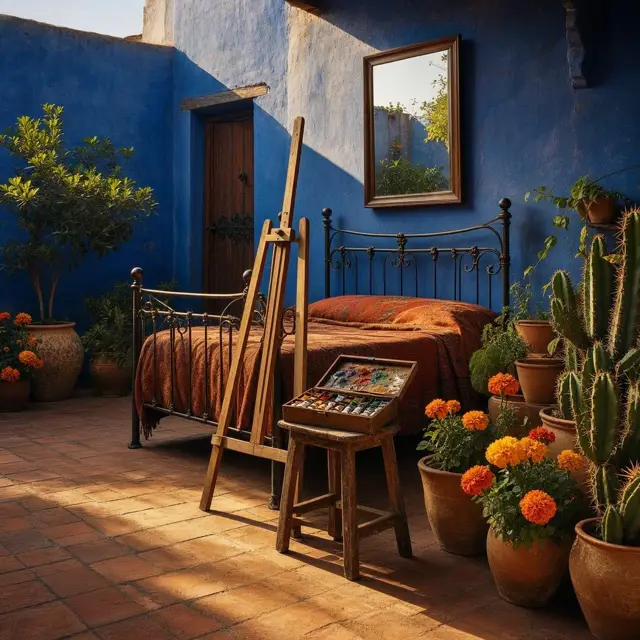
That is when she started to paint. Her mother had an easel made that allowed her to work lying down, her father lent her his oil paints, and a mirror was fixed above the easel so she could see herself.
Her explanation was blunt. She said she painted herself because she was often alone and was the subject she knew best.
Small Paintings in a Country of Murals
When Kahlo began working in the 1920s, Mexican art was dominated by muralists producing enormous public works with clear political messages. She knew them well, shared their politics, and went the opposite way: most of her paintings are self-portraits of modest size.
In 1928 she asked Diego Rivera, whom she had first met when he painted a mural at her school, whether her work was good enough to make a career of. He said it showed unusual energy and a genuine artistic personality of its own. They married the following year.
Her style shifted after moving to Cuernavaca, drawing increasingly on Mexican folk art: flat perspective and elements combined from pre-Columbian and colonial periods.
The form she borrowed from was the retablo, a postcard-sized painting made by amateurs to give thanks after surviving an illness or accident. These strip an event down to essentials, with little background and no realistic perspective. She owned about 2,000 of them and hung them on the walls of her home.
Painting an Identity
Kahlo belonged to Mexicanidad, a movement of romantic nationalism that emerged after the revolution and set out to resist the sense of cultural inferiority left by colonial rule, placing Indigenous cultures at the centre.
Before the revolution, Mexican folk culture had been looked down on by an elite that claimed purely European ancestry and treated Europe as the definition of civilisation. Kahlo said she wanted her paintings to be worthy of the people she belonged to.
She curated the image carefully. She played down the art instruction she had received from her father and at school, cultivating a reputation as self-taught and naive. She began wearing traditional Indigenous dress, long colourful skirts, huipils and elaborate headdresses, favouring the clothing of women from the Isthmus of Tehuantepec.
Her influences were wide, from the Renaissance painters she admired early on to Hieronymus Bosch, whom she called a man of genius, and Pieter Bruegel the Elder, whose attention to peasant life matched her own interest in ordinary Mexicans.
Pain, Politics and Afterlife
The accident caused pain and illness for the rest of her life. A friend said simply that Kahlo lived dying.
In 1950 she spent most of the year in hospital for a bone graft on her spine, which became infected and required several more operations. Afterwards she was mostly confined to La Casa Azul, using a wheelchair and crutches. She kept up political work as far as her health allowed, rejoining the Mexican Communist Party in 1948 and campaigning for peace. She died in 1954.
Her reputation grew enormously after her death, to the point of having its own name, Fridamania. Her 1940 self-portrait The Dream sold in 2025 for 54.7 million dollars, the highest auction price ever paid for a work by a woman.
The repetition in her portraits was deliberate. By painting the same facial features again and again, she drew on traditional Mexican portrait imagery, and on the fascination of her era with the cinematic close-up.