Crossing Greenland With No Way Back
Fridtjof Nansen grew up on skis. He started at the age of two on improvised skis, and at 18 he broke the world one-mile skating record. Later he used those skills for the first crossing of Greenland's frozen interior.
Earlier explorers had started from the inhabited west coast and turned back. Nansen flipped the plan. He would land on the dangerous east coast and ski west toward the towns. That meant no retreat. The only way to go was forward, which suited him perfectly. The press mostly hated the idea, and Norway's parliament refused to pay for it.
In 1888 his team of six hauled their sledges up to 2,719 m (8,921 ft), where nights dropped to minus 45 °C. Near the end, Otto Sverdrup built a makeshift boat out of sledge parts, willows and their tent. They crossed in 49 days. In the town of Godthaab, an official greeted Nansen with surprising news: he had been awarded his doctorate.
Freezing a Ship Into the Ice on Purpose
Nansen's next idea sounded even crazier. In 1881 the American ship Jeannette was crushed and sank off Siberia. Later, items from it turned up on the coast of Greenland, on the far side of the Arctic Ocean. A meteorologist, Henrik Mohn, reasoned that a current must flow across the polar sea, possibly right over the North Pole.
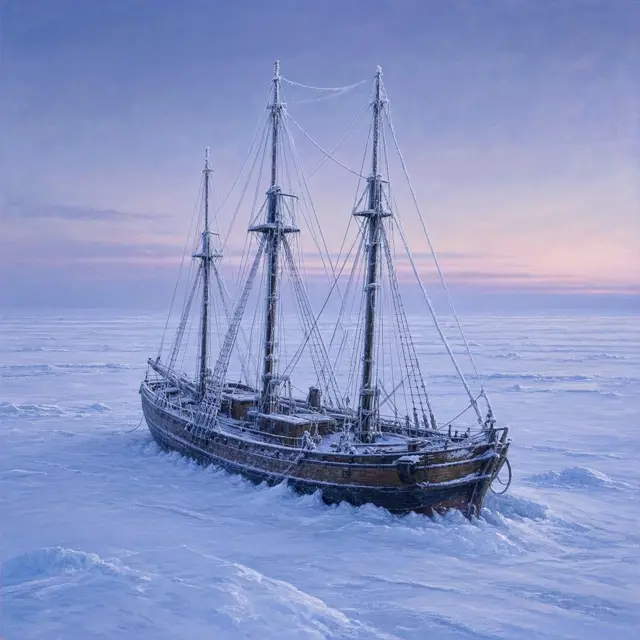
Nansen's plan: stop fighting the ice. Sail a ship into the pack ice near where Jeannette sank and let the current carry it. Veteran explorer Adolphus Greely called it 'an illogical scheme of self-destruction'.
Designer Colin Archer built the Fram from the toughest oak, with a rounded hull so that squeezing ice would push the ship upward. Thousands applied to join. Hjalmar Johansen, an army lieutenant, signed on as the ship's stoker because it was the only job left. In 1893 the Fram entered the ice and the drift began, sometimes north and, annoyingly, sometimes south.
Forgotten Watches and a Lucky Walrus
The drift was too slow, so in March 1895 Nansen and Johansen left the ship with dogs, sledges and kayaks to make a dash for the pole. They reached a record latitude of about 86 degrees north, almost three degrees beyond the previous record, before a chaos of ice blocks made them turn back.
Then came a classic blunder. In their rush to break camp, they forgot to wind their watches, each a chronometer they needed to work out their position. They spent a whole winter in a hut of stones and moss, eating bear, walrus and seal. Their main enemy was not hunger but boredom.
In June 1896, a walrus attacked their kayaks and forced a stop. Nansen heard a dog barking and human voices. It was British explorer Frederick Jackson, who asked, 'You are Nansen, aren't you?' Without that walrus delay, the two might never have known the other was there.
Inventor and Ocean Detective
Nansen was also a serious scientist. As a young zoologist, he studied the nervous systems of simple sea creatures and became the first Norwegian defender of the neuron doctrine. On his first sea voyage in 1882, his water samples showed that sea ice forms on the surface of the water, not below it as people had assumed.
After the Fram, he switched to oceanography. His current readings from the drift helped physicist Walfrid Ekman show that wind drives ocean currents in something like a spiral staircase going down into the depths. Nansen also designed the 'Nansen bottle' for collecting deep water samples, and an updated version stayed in use into the 21st century.
His gear changed polar travel, too. He invented the Nansen sledge with broad, ski-like runners, the Nansen cooker, which got more heat out of the camp stoves of the time, and the idea of wearing several layers of light clothing instead of heavy, awkward garments.
A Passport for People With No Country
In his final decade, Nansen turned to helping people. After World War I, the League of Nations asked him to bring home prisoners of war stranded around the world. By 1922 he reported that 427,886 of them had returned to about 30 countries.
As the League's High Commissioner for Refugees, he faced a tricky problem. Many refugees had no papers proving who they were, so they could not legally go anywhere else. Nansen's fix was the 'Nansen passport', an identity document for stateless people. In time, more than 50 governments recognised it.
In 1922 he won the Nobel Peace Prize, and he gave the prize money to international relief work. After he died in 1930, the League set up the Nansen International Office for Refugees, which won the Nobel Peace Prize itself in 1938. Today his name sits on an asteroid, a basin in the Arctic Ocean, mountains in Antarctica and even craters on the Moon and Mars.