A Better Spyglass
Galileo was born in Pisa in 1564 and worked as an astronomer, physicist and engineer. He has been called the father of observational astronomy and of modern science, though the instrument that made him famous was not his invention.
In 1608, Hans Lippershey tried to patent a practical telescope in the Netherlands. Galileo, working possibly from nothing more than descriptions of it, built his own the following year with about three times magnification, then improved it steadily until it reached around thirty.
On 25 August 1609 he demonstrated one to the lawmakers of Venice. It was good business as well as good science: he sold telescopes to merchants, who found them useful at sea and worth trading.
He was one of the few people who could make an instrument good enough to look at the sky. In March 1610 he published his first telescopic observations in a short book called Sidereus Nuncius, the Starry Messenger.
Four Points of Light Near Jupiter
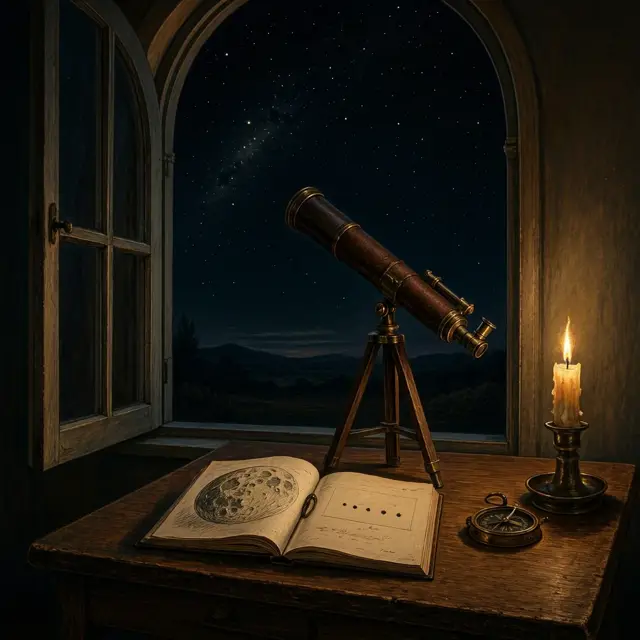
On 30 November 1609 Galileo turned the telescope on the Moon. An English mathematician had looked before him and seen only a strange spottedness. Galileo worked out that the uneven edge of light was caused by mountains and craters, and he charted them and estimated their heights. The Moon was not the perfect smooth sphere that received wisdom described.
On 7 January 1610 he noticed three faint points of light beside Jupiter, lying in a straight line. Over following nights they moved in ways fixed stars could not, one vanished behind the planet, and a fourth appeared. By 15 January he concluded they were orbiting Jupiter.
This mattered because the accepted cosmology said everything circles the Earth. Some astronomers refused to believe it, and others could not reproduce the observation with weaker instruments. One critic argued the telescope was simply deceptive.
From September 1610 he watched Venus run through a full set of phases like the Moon, which geocentrism, the Earth-centred model, could not explain.
Ordered to Stop
Galileo argued for heliocentrism, the Copernican idea that the Earth moves around the Sun. The objections were both religious and scientific.
The scientific one came from Tycho Brahe, who pointed out that a moving Earth should make the stars appear to shift over a year, an effect called parallax, and no such shift had been measured. The answer, as Copernicus had guessed, was that the stars are simply too far away for it to show, but that could not be demonstrated yet.
In 1613 Galileo wrote to a friend arguing that scripture was an authority on faith and morals rather than on astronomy. The letter was never published but circulated widely, and in 1615 it was submitted to the Roman Inquisition.
In February 1616 a commission declared the moving Earth to be contrary to scripture, and Galileo was ordered not to hold, teach or defend the idea in any way. He kept away from the subject for the next decade.
The Book That Cost Him
In 1623 a friend and admirer, Cardinal Maffeo Barberini, became Pope Urban VIII, and Galileo took it as an opening. He wrote his Dialogue Concerning the Two Chief World Systems, published in 1632 with formal permission.
The Pope had asked him to present both sides without advocating. The character defending the old Earth-centred view in the book is repeatedly caught in his own errors, and his name carries a suggestion of simpleton in Italian. Most historians think Galileo did not intend the insult and was genuinely surprised by the reaction.
He was called to Rome, tried in 1633, found vehemently suspect of heresy, and required to renounce the view. He spent the rest of his life under house arrest, and publication of anything he wrote was forbidden.
He wrote his best physics anyway. Two New Sciences was smuggled out and published in Holland, summarising work done forty years earlier on motion and the strength of materials. He went blind in 1638. The famous line "and yet it moves" first appears in writing a century after his death.