A Hanging Chain, Flipped Upside Down
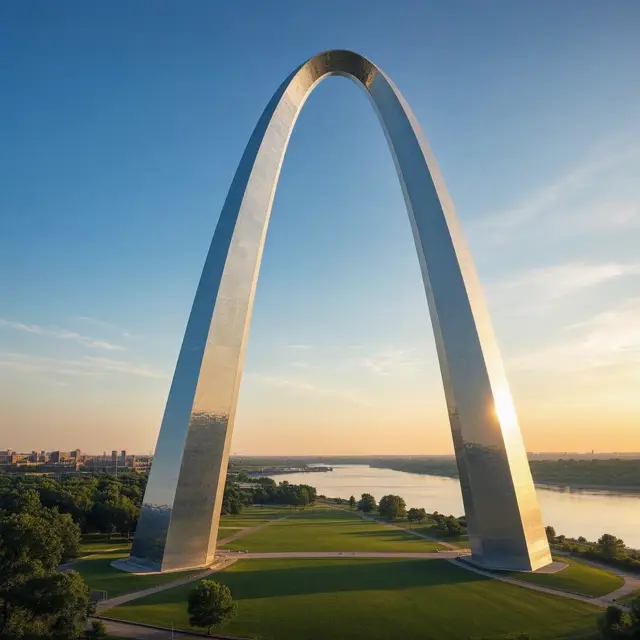
The Gateway Arch in St. Louis, Missouri, is exactly as wide as it is tall: 630 feet (192 m) each way. It is the world's tallest arch and the tallest stainless steel monument on Earth. It stands beside the Mississippi River, where St. Louis was founded in 1764.
Its shape comes straight from math. Hang a chain by its ends and it sags into a curve called a catenary. Flip that curve upside down and the arch only pushes straight down through its legs, with no force trying to spread them apart. That makes the catenary the most stable of all arches.
Designer Eero Saarinen tweaked the recipe. The Gateway Arch is a weighted catenary, with legs that slim down from 54 feet per side at the base to 17 feet at the top. He picked it because it looked less pointed and less steep. People often call it a parabola, but Saarinen himself wrote that it is not one.
Winning a Contest by Number
The arch began as a design contest. In 1947, judges looked at 172 entries labeled only by numbers, with the designers' names kept secret. Saarinen's entry, number 144, made the final five. One judge called it "relevant, beautiful, perhaps inspired."
Then came a mix-up. Saarinen's father, the architect Eliel, had also entered. The secretary sending out the good news sent the telegram to Eliel instead of Eero. The family celebrated, until a contest official called two hours later to fix the mistake.
In February 1948, the jury chose Eero's design unanimously. It was the first major design he developed without his father's help. He later raised the arch's height from 580 feet to 630 feet. Not everyone loved it at first: some locals compared it to a "stupendous hairpin and a stainless steel hitching post." Building it would cost $13 million.
Building in Curves
Construction of the arch began on February 12, 1963. It went up as 142 stainless steel sections, each 12 feet long and shaped like a triangle that got smaller toward the top. Cranes and derricks lifted each piece into place, and the double-walled skin of each section was filled with concrete.
The project manager said a 62-story building would have been easier. "In a building, everything is straight up, one thing on top of another. In this arch, everything is curved." To keep the half-built legs steady, workers braced them with a truss at 530 feet, removed later.
Crowds loved watching. In 1963, a million people came to see the progress, and the contractor built a 30-foot tower just for spectators. By 1964, local radio stations announced when big slabs of steel would be lifted. A newspaper photographer crawled along the catwalks with the workers, up to 620 feet above the ground.
The Fire Hose Finish
On October 28, 1965, the last piece was ready to go in. This keystone was a triangular section weighing 10 short tons and measuring eight feet long. Sealed inside it was a time capsule holding the signatures of 762,000 students and others.
Heat nearly spoiled the day. Thermal expansion had made the steel grow, shrinking the 8.5-foot gap at the top by 5 inches. So workers sprayed the south leg with fire hoses to cool it down and make it shrink. The keystone went in within 13 minutes with only 6 inches to spare, half an hour earlier than planned.
For the next section, a hydraulic jack had to pry the legs six feet apart. Some filmmakers had recorded every stage, hoping to catch the two legs failing to meet. They never got that shot. The visitor center opened to the public on June 10, 1967, and the trams started carrying riders that July.
A Tiny Ride to the Top
Getting to the top is half the fun. Each leg hides a tram made of eight small round capsules with five seats each. The capsules rotate like Ferris wheel cars as they climb, so the ride is called "half-Ferris wheel and half-elevator." It takes four minutes up and three minutes down.
At the top, an arched deck about 7 feet wide holds up to 160 people. Sixteen small windows on each side offer views up to 30 miles away. If the tram is out, each leg also has 1,076 emergency steps.
The arch is built to move. It can sway up to 18 inches in either direction and stand up to winds of 150 miles per hour. Its outer skin used more stainless steel than any other single project in history. Since 1965, pilots have been warned they would lose their licenses for flying through it, yet at least ten have done it anyway.